At about half past one the light goes flat. The hills along the eastern edge of the city lose their outline, the grey comes down off the mountains, and twenty minutes later the gutters on Carrera Séptima are running hard enough to stop you crossing at the corner. Bogotá does not argue with this. It steps inside, orders something hot and thick, and waits. The waiting, done with any planning at all, is one of the better things this city hands a visitor.
What happens at two o'clock
The city sits at roughly 2,640 metres on a high plateau with a wall of mountains down its eastern side. Morning sun heats the savanna, the warm air climbs the slope, and by early afternoon it comes back down as rain. That is the entire mechanism, and it is why the storms feel punctual rather than random: cold, bright mornings under hard light, then a grey ceiling somewhere between one and four o'clock.
Two stretches of the year do this with real conviction, roughly April into May and October into November. Outside those windows the pattern still holds, just with fewer wet days a week, so the planning advice never really changes. When it breaks, the temperature drops fast, from something like 19°C to 11°C inside half an hour, and a few times a year it hails hard enough to be loud on tile roofs. The rain itself is usually an hour, sometimes two, occasionally twenty minutes of drama and then sun on wet brick.
The practical consequence is the single most useful piece of logistics in Bogotá: put everything outdoors in the morning. Hill walks, cycle lanes, street art, markets, anything with a view. By half past one, have a roof chosen. You cannot improvise shelter well here. Crossings flood ankle-deep at the kerb, every taxi on the street is already taken, and the thing you wanted to do is nine blocks away.
One more thing if you have just landed. At this altitude your first afternoon will feel like you have been walking uphill all day, because in effect you have. On day one, two hours of storm and a cup of chocolate is the right way to spend an afternoon rather than a wasted one.
The breakfast you order in the afternoon
The ritual has a name, chocolate santafereño, and no fixed hour. Hot chocolate whisked to a foam with a wooden molinillo, a slab of fresh white cheese dropped in to go soft and stringy, an almojábana (cheese bread, faintly sour from the curd) and pan de yuca alongside. Written down it sounds like a dare. Eaten once during a thunderstorm, the argument is over.
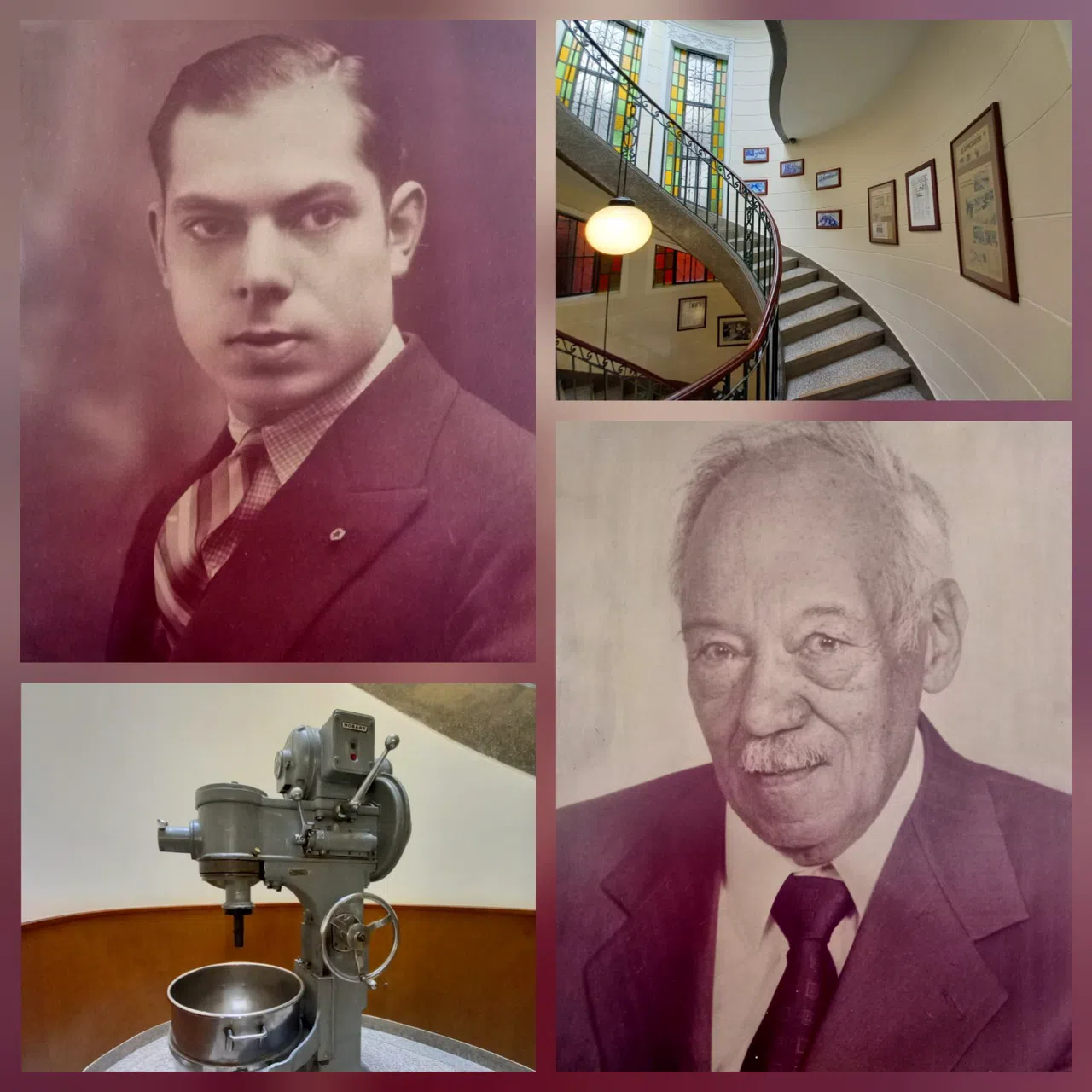
Pastelería Florida (centre, on Carrera Séptima, a short walk from the Avenida Jiménez axis) opened in 1936 under a Catalan pastry chef and remains the most reliable address in the historic centre to order the whole thing in one sitting rather than assembling it across three counters. It is a big room with proper tables and waiters who have seen weather. A chocolate santafereño set runs COP 20,000 to 45,000. Groups of eight to twelve genuinely work here, because the kitchen is used to sending a full santafereño breakfast out to one table at once, but call ahead on a weekend morning, when it fills with families who have been coming for decades. Couples get seated without trying. It is not an intimate room, it is a civic one, and that is the point when you need to kill two hours.
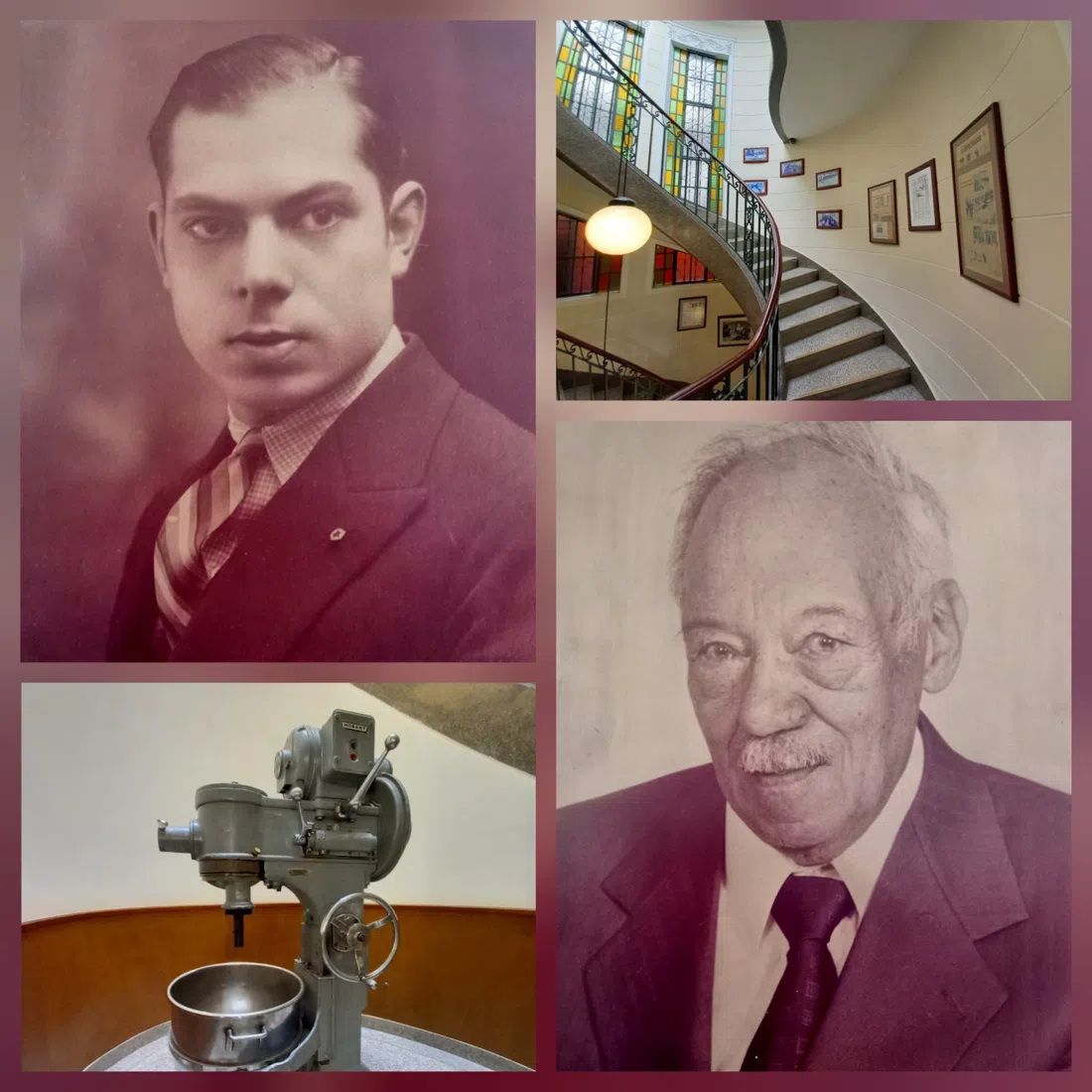
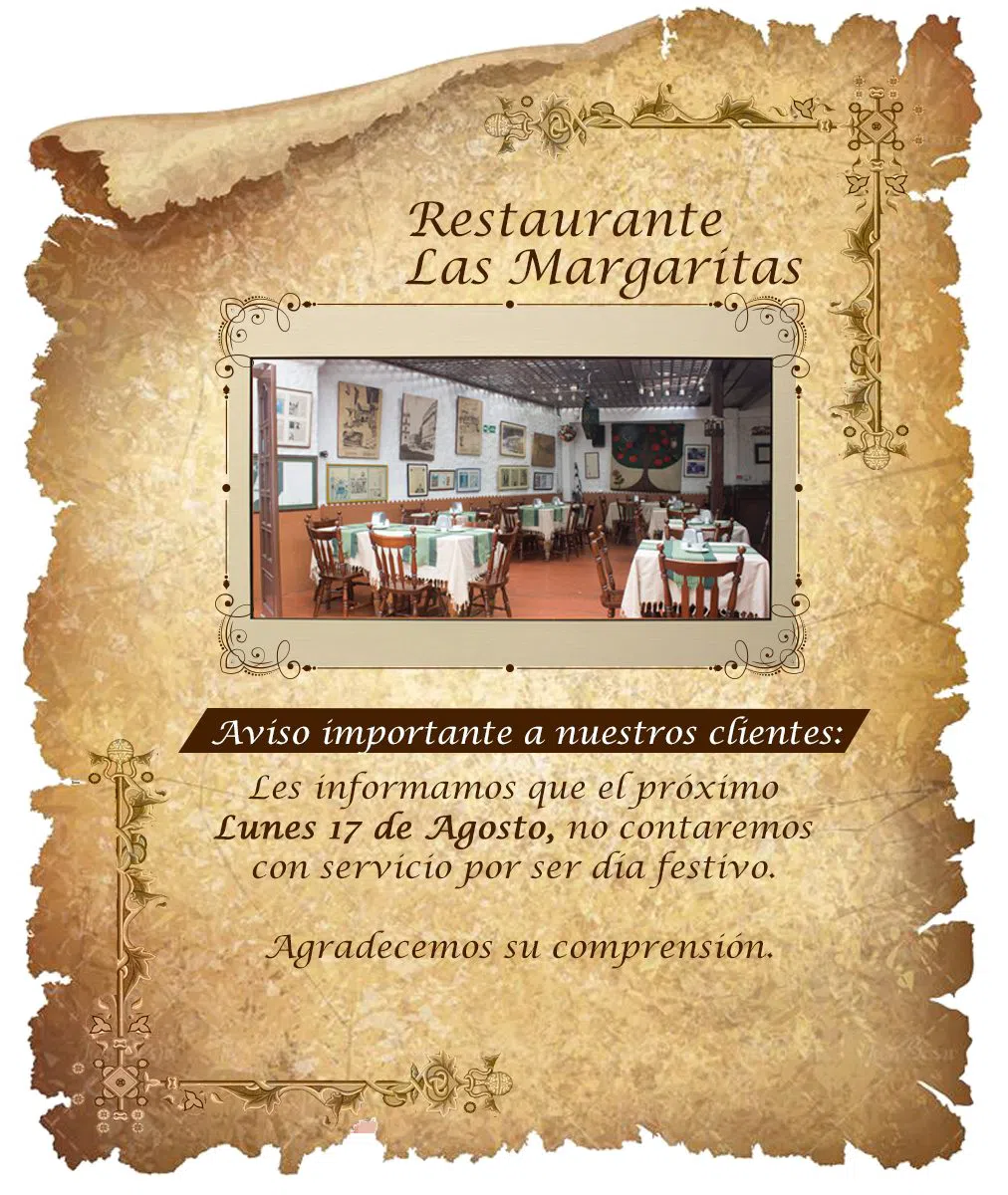
Restaurante Las Margaritas (Chapinero) has been trading since 1902 and is still the benchmark for chocolate with almojábanas, served alongside cuchuco and the rest of the old santafereño repertoire, at COP 35,000 to 70,000 a head. The problem here is never the cooking, it is the calendar. Weekdays are reservation-only for private and corporate bookings; the service open to the public runs Saturdays, Sundays and holidays, roughly 8:30am to 4pm. The owners have also been openly seeking a buyer for several years. So telephone before you build a rainy afternoon around it. That call is the difference between the best chocolate of your trip and a locked door in the rain.
Two roofed streets in La Candelaria
Pasaje Rivas (La Candelaria, a block from the main square) was promoted in 1893 as the city's first shopping arcade, a covered street of glass and iron built so people could shop without weather, and it is now the oldest craft market in Bogotá. It is free, there is no door, and nobody vets you: you walk in dripping and nobody looks up. Ruanas, hammocks, baskets, clay, carved wood, woven mochilas, anywhere from COP 10,000 for a trinket to COP 200,000 for something you will still own in ten years. The aisles are narrow and stacked to head height, so a group of twelve becomes a single file within thirty seconds. That is fine, just agree in advance where you will meet at the far end.
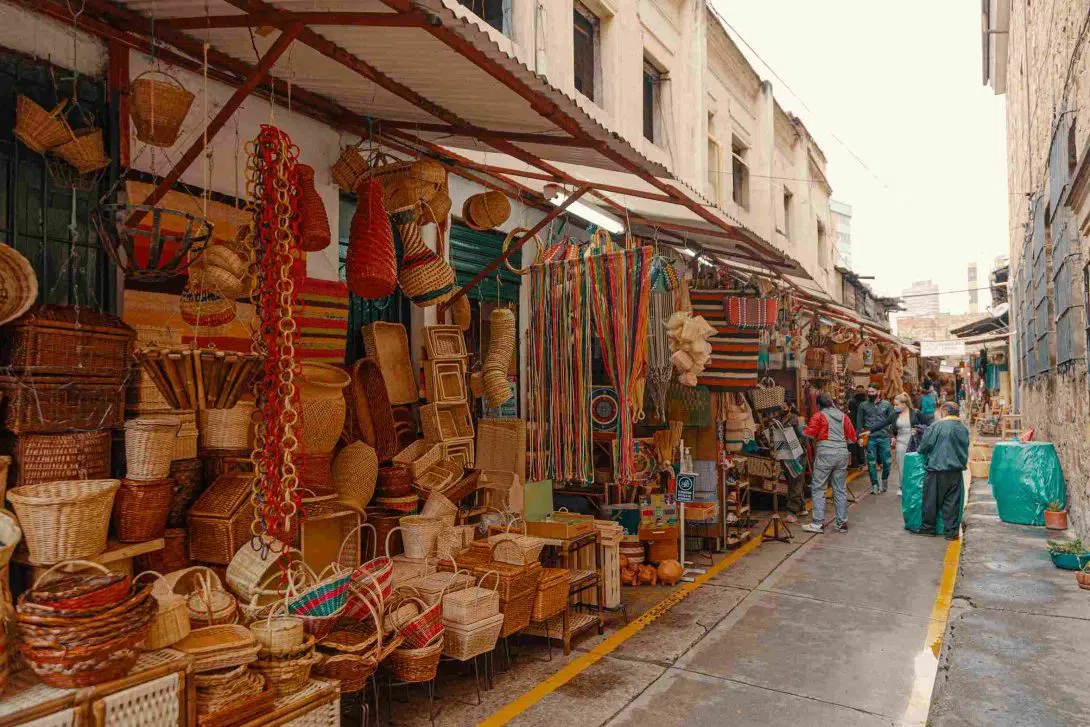
Come here for something better than a dry place to browse: a wool ruana at COP 60,000 to 120,000 solves the other half of a Bogotá storm, which is the ten-degree temperature drop that arrives with it. Buy the warm thing on the first wet day, not the last.
Pasaje Hernández (La Candelaria, just off Carrera Séptima near Calle 12) dates to March 1893 and was the city's first commercial centre. The ground floor has drifted into selling everything, phone cases, uniforms, odds and ends, so go for two specific things. First, the glazed roof, the best piece of nineteenth-century engineering you can stand under for free in the centre. Second, the surviving second-floor sastres, still cutting cloth upstairs while the trade below moved on.
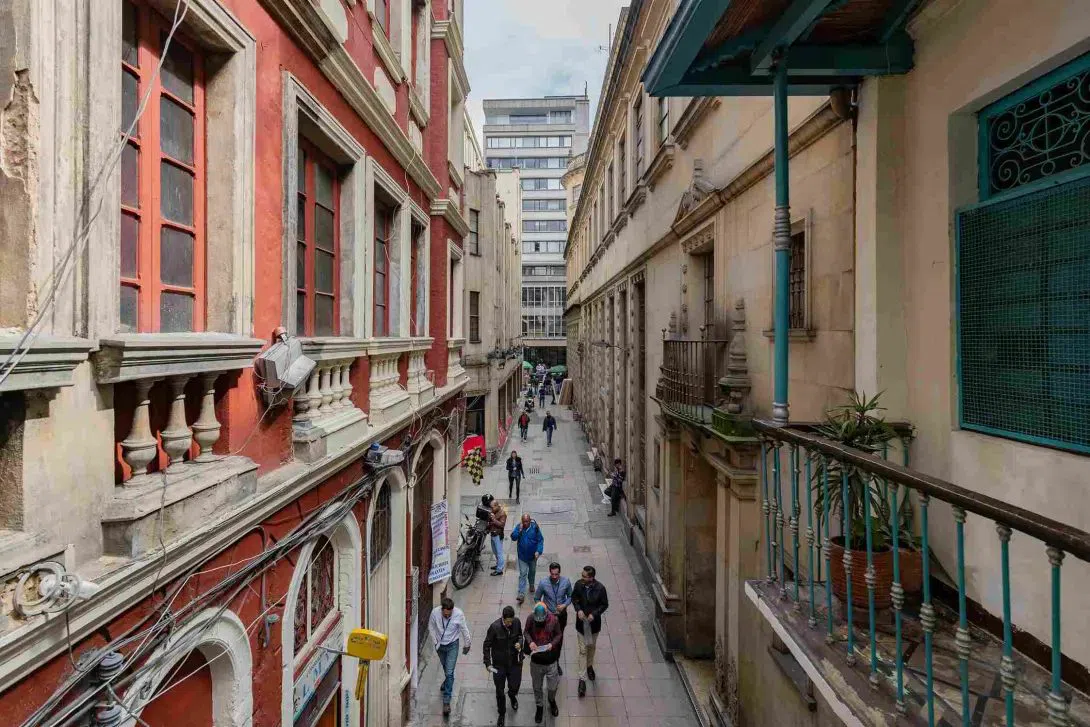
Those are one- and two-person workshops, so send two people up, not ten; a tailor measuring a jacket does not want a tour group on the landing. If you are in town a week or more, made-to-measure is a real option here, but prices vary too widely to quote honestly. Ask for the price per garment and the fitting schedule before you commit to anything.
A market the weather cannot touch
Plaza de Mercado de Paloquemao (Los Mártires, west of the centre) opened in 1971 and is completely roofed, which makes a tropical-fruit tasting the one food plan in this city that the sky cannot cancel. Lulo, guanábana, granadilla, mangostino, feijoa, borojó, chontaduro: fruit that largely does not travel, cut in front of you, half of it unrecognisable even if you think you know fruit. Several operators run three-hour tastings, shared and private, in English and Spanish, usually meeting at Gate 10, with minimums of about two people and a typical range of COP 120,000 to 250,000 per person depending on group size. Entry to the market itself is free if you would rather simply wander and buy by the bag.

The honest catch is timing, and it inverts everything else in this article: Paloquemao is a morning rather than a storm shelter. The flower hall and produce aisles are at full tilt between roughly 6 and 9am, and the whole place winds down and closes around 4:30pm. So go early, eat things you cannot name, and be back in the centre with a roof picked out before one o'clock. Groups are easy here, since the building is built for volume and nothing you do will crowd it.
Windowless hours in the centre
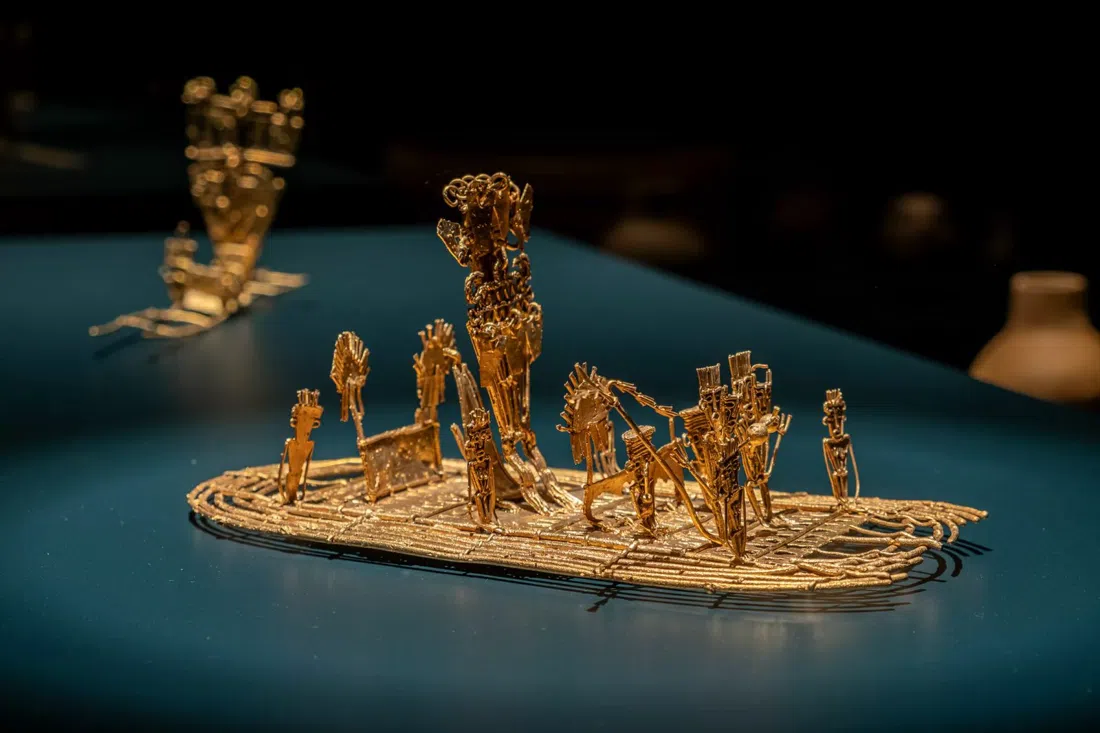
Museo del Oro (centre, on Parque Santander) is the default two-hour refuge, and it is considerably better than its guidebook ubiquity suggests. The galleries are deliberately windowless, with no daylight and no sense of the hour, so the storm stops existing for the length of your visit, which is the specific reason to pick it over any other museum on a bad afternoon. Admission is COP 21,000 for foreign visitors and COP 10,000 for Colombians, roughly five US dollars either way, and free on Sundays. Hours are Tuesday to Saturday 9am to 7pm and Sunday 10am to 5pm, and it is closed Mondays, which matters more than it sounds: a Monday downpour needs an entirely different plan. School and tour groups come through daily with guided visits and audio guides, so a large party is no trouble, though the small offering rooms land better with two of you than with twelve.
Museo Nacional de Colombia (Santa Fe, Carrera Séptima at Calle 28) is the long-storm option: enormous, thick-walled, and almost comically cheap at COP 3,000 for adults, COP 2,000 for teenagers and COP 1,000 for children, with free entry on Wednesdays from 2 to 5pm and on the last Sunday of each month. That Wednesday window lands squarely on the two o'clock rain, which is either coincidence or the most bogotano piece of scheduling in the city. The caveat is genuine: the permanent galleries are mid-renovation, so expect some halls shut, and lead with the temporary exhibitions, which have been carrying the building. It also closes Mondays. Groups and school parties are handled daily with guided visits.
Free rooms where nobody rushes you
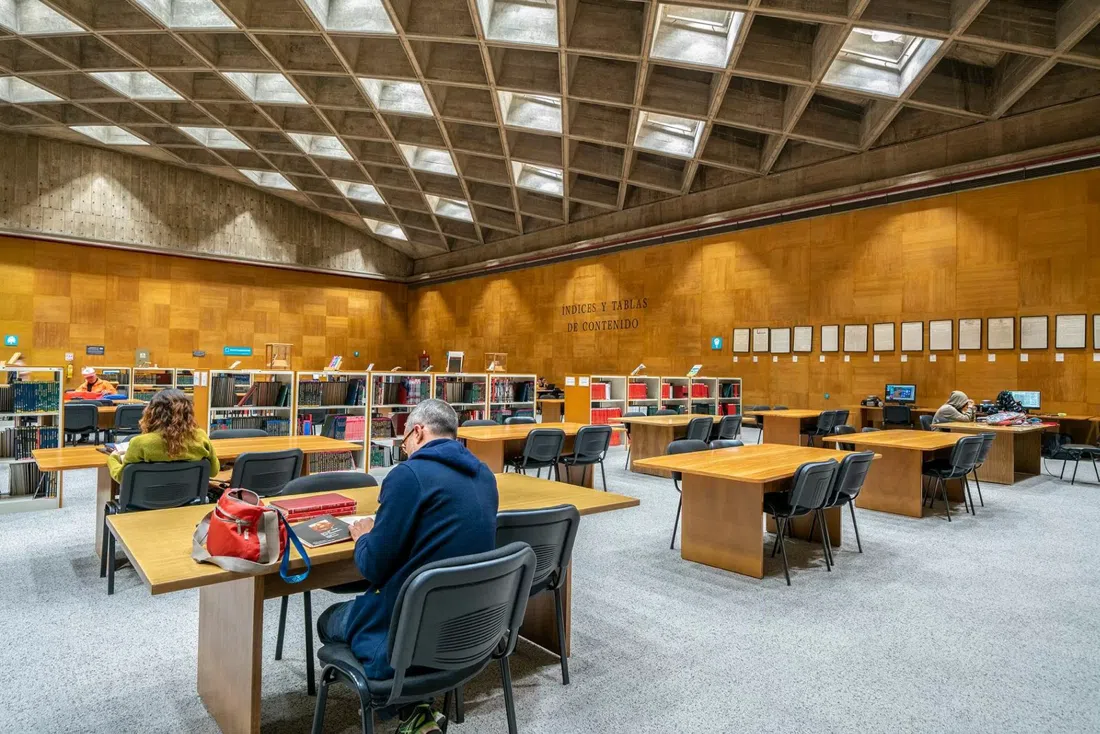
Biblioteca Luis Ángel Arango (La Candelaria) is the move no guide prints. It is free, open to anyone who walks in off the street, and warm, with halls for Arts and Humanities and for Science and Technology plus a Hemeroteca full of newspaper runs. You can sit for three hours and nobody will sell you anything or ask you to order a second coffee. Two conditions. It is a working reading room used by students, so go in ones and twos and keep your voice down; the attached concert hall and exhibition spaces are where a group properly belongs, so check what is on when you arrive. And it closes on Tuesdays, which is exactly the trap you will fall into if you only remember the Monday museum closures.
Centro Cultural Gabriel García Márquez (La Candelaria) is simply the best architecture in Bogotá to be stuck inside: a curved brick building with ramps worth walking twice, a bookshop deep enough to lose a whole storm in, an exhibition hall, auditoriums, and a café for when your legs go. Free to enter, coffee COP 6,000 to 18,000, books whatever books cost. Open Monday to Saturday 9am to 7pm and Sunday 10:30am to 5pm. With more than 350 events a year there is usually something free to sit in on, and the building absorbs groups without strain. If a group and a couple need to split up for an afternoon, this is the obvious place to reconvene.

Putting a wet day in order
Run it in order rather than picking from a list. Half past seven at Paloquemao, out by ten. Eleven o'clock in the Candelaria arcades, Rivas then Hernández, five minutes apart on foot. Half twelve for chocolate at Florida, which is also where you wait if the rain comes early. Two o'clock, when it breaks, into the Gold Museum or the Museo Nacional depending on how long you want to be indoors. From half four, the library or the cultural centre until dinner.
The day traps are worth stating plainly. On Mondays both museums are shut, while the arcades, Florida, the library and the cultural centre are all open, so a Monday storm is a reading-and-shopping day and you should stop fighting it. On Tuesdays the library is shut and the museums are open, the exact reverse. At weekends Las Margaritas serves the public and the museums are at their busiest; the Gold Museum's free Sunday is crowded from about eleven to two, so go at opening.
The biggest weather decision, though, is where you sleep. Staying in or immediately beside La Candelaria turns every one of these into a five-to-fifteen-minute walk instead of a taxi you cannot find in the rain. See the Bogota hotel search for what sits inside that radius, and the broader Bogota guide for the dry half of the day.
Practical notes for a rainy week
Rain breaks the city's traffic. Ride-hailing and taxi apps surge and crawl at once, and the 4:30pm to 7:30pm window is the worst of it. The bus trunk lines along the Caracas and Séptima corridors keep moving but the queues lengthen badly in a storm. Inside the historic centre, walking under awnings is usually faster than anything with wheels.
The currency is the Colombian peso. Museums, Florida and the cultural centre's café all take cards; the arcade stalls and market vendors are cash, and they prefer small notes, so carry COP 10,000 and 20,000 bills rather than arriving with a fresh 100,000. Withdraw inside a shopping centre or bank lobby, not on the street.
On timing: outdoors before one, indoors after. Paloquemao closes around 4:30pm. Museums shut Mondays, the library shuts Tuesdays, Las Margaritas takes the public Saturdays, Sundays and holidays only.
A full rainy day runs under COP 100,000 before the fruit tasting: chocolate set COP 20,000 to 45,000, arcades free, Gold Museum COP 21,000 or the Museo Nacional COP 3,000, library and cultural centre free, coffee COP 6,000 to 18,000.
Wear layers and a waterproof shell. An umbrella is useless in the gusts that come with the heavier storms, and you want shoes you do not mind soaking at a flooded kerb. At this altitude the sun burns through a cold morning, so keep sunscreen in the same pocket as the rain jacket.