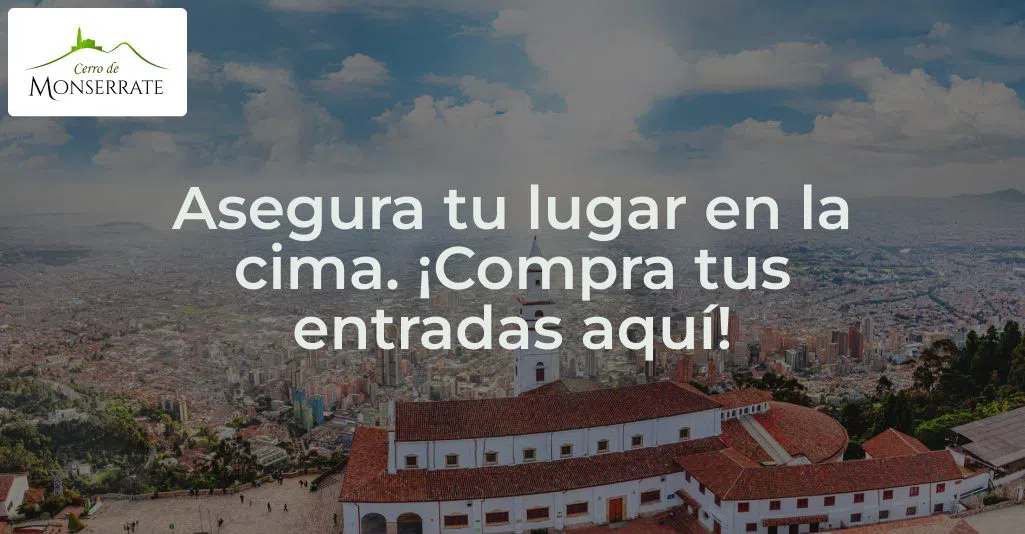
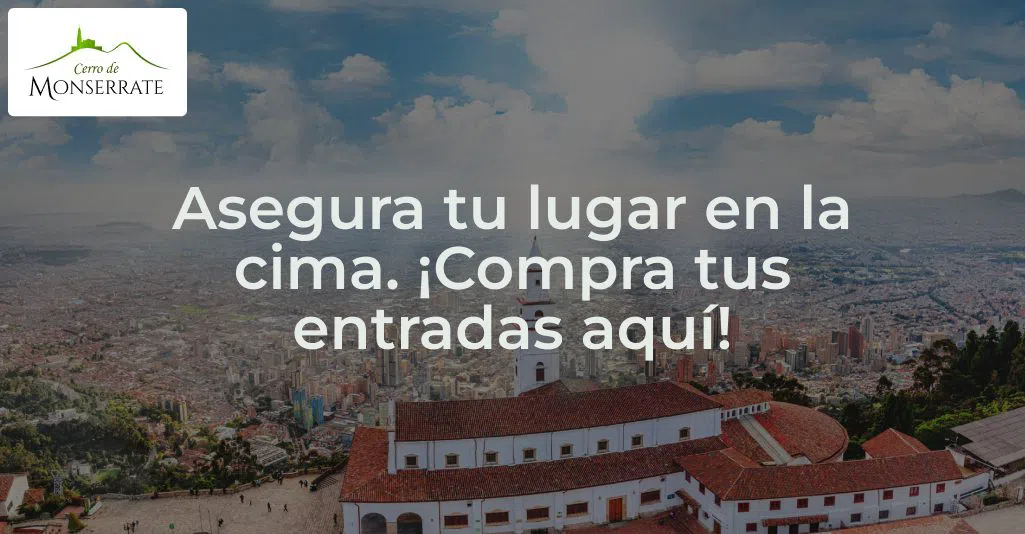
Bogota never lets you lose track of Monserrate. The hill stands along the eastern edge of the city like a wall with a small white church balanced on top, and from most streets in the historic centre you can look up and see exactly where you are going. The climb is not what catches people out, since a mountain railway and a cable car do that part for you. What catches them out is the thin air at the summit, the cloud that rolls in during the early afternoon, and the fact that the two machines do not always both run on the day you turn up.
Getting up the hill
Cerro de Monserrate Funicular & Teleférico (lower station at Monserrate, immediately east of La Candelaria) is the main access and the one thing worth checking before you commit a morning to the mountain. The funicular hauls you up the face of the hill on a fixed track, enclosed and steady, the slope pressing in on both sides. The teleférico covers the same climb in a glass cabin that swings clear of the trees, so the city unrolls behind you as you rise. Take one up and the other down if both are running. They are genuinely different rides, and the moving view only exists on the cable car.
The timetable decides the shape of the visit. Service runs Monday to Saturday 6:30am to 10pm, Sunday 5:30am to 5pm, and 6:30am to 5pm on public holidays. Read that Sunday line twice: the hill closes at five, so a Sunday sunset is not on offer. The operator is part-way through a multi-year modernisation and has repeatedly dropped to cable-car-only running for weeks at a stretch, most recently in a weekday cable-car-only window at the end of September 2026. Do not assume the funicular is working. Check monserrate.co on the morning you go, and if you specifically want the railway, keep a spare day in reserve.
What the ride costs at the door
A round trip is COP 35,000 Monday to Saturday and on holidays, and COP 21,000 on Sundays. That Sunday fare is the cheapest way up and also the reason Sunday is the busiest day on the mountain, so you pay the saving back in queueing. A one-way ticket is COP 21,000, which only makes sense if you plan to walk the other leg. Travellers aged 62 and over pay COP 29,500, and there are priority queue lanes for seniors and for anyone with reduced mobility. Use them, and say so at the station rather than joining the main line and hoping.
A Fast Pass costs COP 96,500, close to three times the standard weekday round trip. It earns its money only on a Sunday or a holiday, when the queue rather than the fare is your problem. Dogs ride for COP 12,500, Monday to Saturday only. Groups of twenty or more adults pay COP 29,500 each and school parties COP 21,000, arranged in advance through the operator's bulk sales desk at [email protected] or WhatsApp 311 3508583. If you are moving a coach party, that call is the difference between a smooth boarding and an hour lost at the turnstiles.
The basilica is why the hill exists
Basílica Santuario del Señor Caído y Nuestra Señora de Monserrate (summit) is free, with no ticket and no door policy, and for most of the people standing around you it is the point of the trip. It is a working sanctuary rather than a monument, and that changes how you behave inside. Colombian pilgrims come up in family groups, many of them for the image of the Fallen Lord, and the building stays quiet enough to surprise anyone who expected a viewpoint with a chapel attached.
It opens Monday and Wednesday to Sunday 6am to 7pm, and Tuesday from noon to 7pm. Mass runs most days, and Sunday is by far the heaviest: 6:30, 8:00, 9:30 and 11:00am, then 12:30 and 2:30pm. There is no in-person Eucharist on Tuesdays. Guided parties are welcome but are asked to keep quiet and stay clear during Mass. If you want to study the interior rather than stand at the back of a service, come midweek in the morning.
The sculpture walk almost everyone skips
Vía Crucis Gardens & Pozo de los Deseos (summit, laid out behind and below the sanctuary) is what day-trippers walk straight past, and it rewards a slow half hour. Fourteen life-size Stations of the Cross, brought from Italy in the nineteenth century, are set through terraced flower beds and running water, so the route reads as a garden and a devotional sequence at the same time. It is open air, free once you are up here, and has no limits on numbers, which makes it the obvious place to park a group while one person queues for lunch or tickets.
At the Pozo de los Deseos you flick a coin through a metal hoop. It is a small local ritual, it costs nothing, and watching families take turns at it tells you more about what this hill means to Bogota than any plaque on the summit.
Standing at 3,152 metres
Mirador de Monserrate (summit terraces) is what most people actually came for, and it sits at 3,152 metres, high enough that the official kit advice is worth taking seriously. Bring a light jacket, something for rain, sunscreen, and shoes you can grip in: the paths up here are steep cobble and the weather turns within minutes. The terraces are unrestricted and free, but the rail space tightens badly in the last hour of light, so arrive early if you want a position rather than a gap between shoulders.
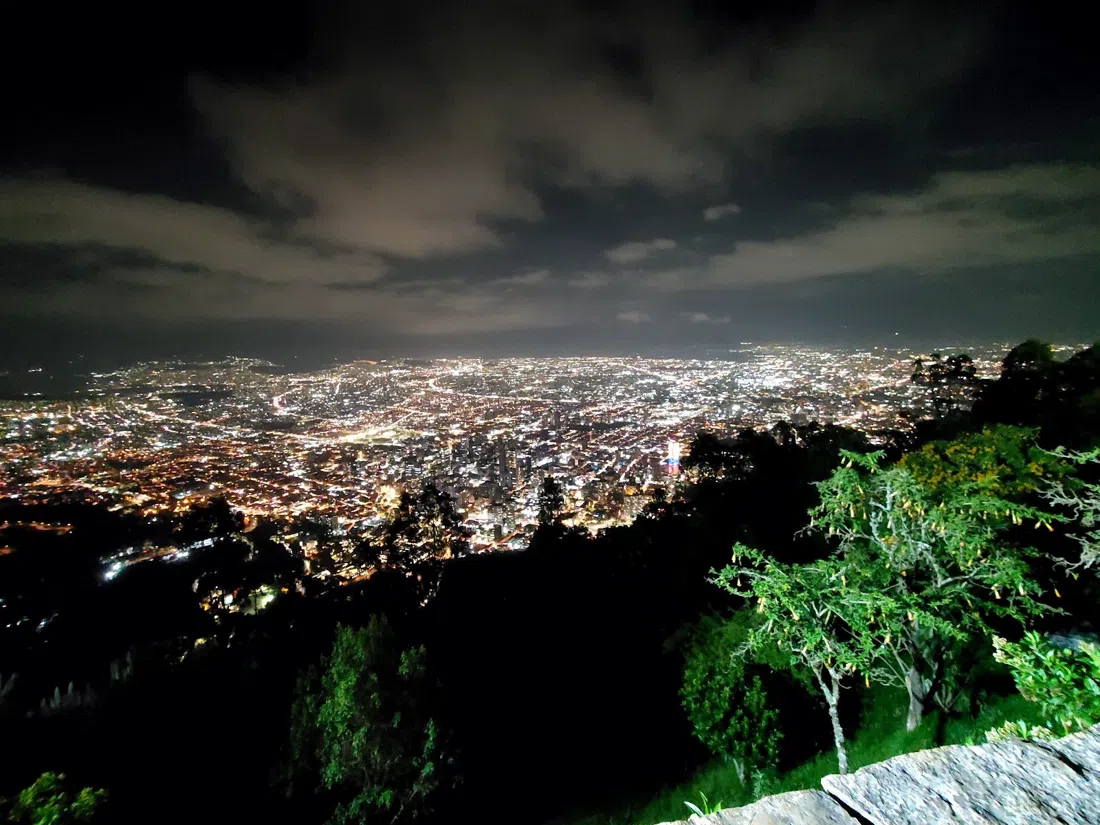
The best light is between 6:30 and 9:00am, before the afternoon cloud builds and the plain below disappears into grey. The alternative is to come after 3pm and watch the city switch its lights on, which gives you the better photograph and the worse crowd. On Sundays and holidays the last descent is at five, so the lights plan only works Monday to Saturday.
Eating up there
Restaurante Casa Santa Clara (summit) is where most people should eat: ajiaco, Tolima tamal, bandeja paisa, crisp empanadas and chicharrón, with mains from around COP 35,000 and a long day of service running roughly 9am to 10pm. It takes groups and coach parties without drama. Below the main room there is a café-bistró doing coffee, desserts and Irish coffee. Treat it as the same place, and as the right reward if you walked up.
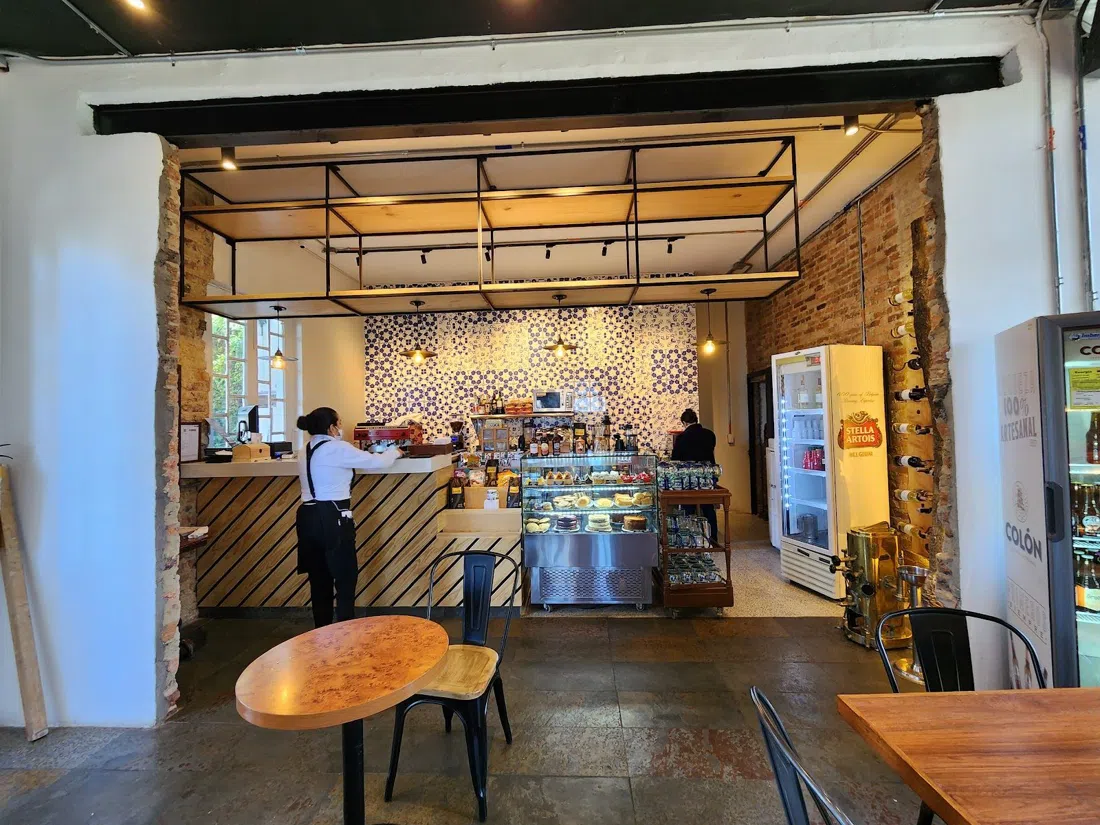
Restaurante Casa San Isidro (summit, at Paseo Bolívar by the funicular station) is the grown-up option, a genuinely good building as well as Bogota's top-end view table, at $$$$ prices and by reservation only, phone or email, groups and private hire included. It is not a walk-in. It runs Monday to Saturday noon to 10pm with last entry at 9pm, and it closes on Sundays, the exact day most visitors choose because the fare is cheapest. That one line ruins more plans on this hill than anything else.

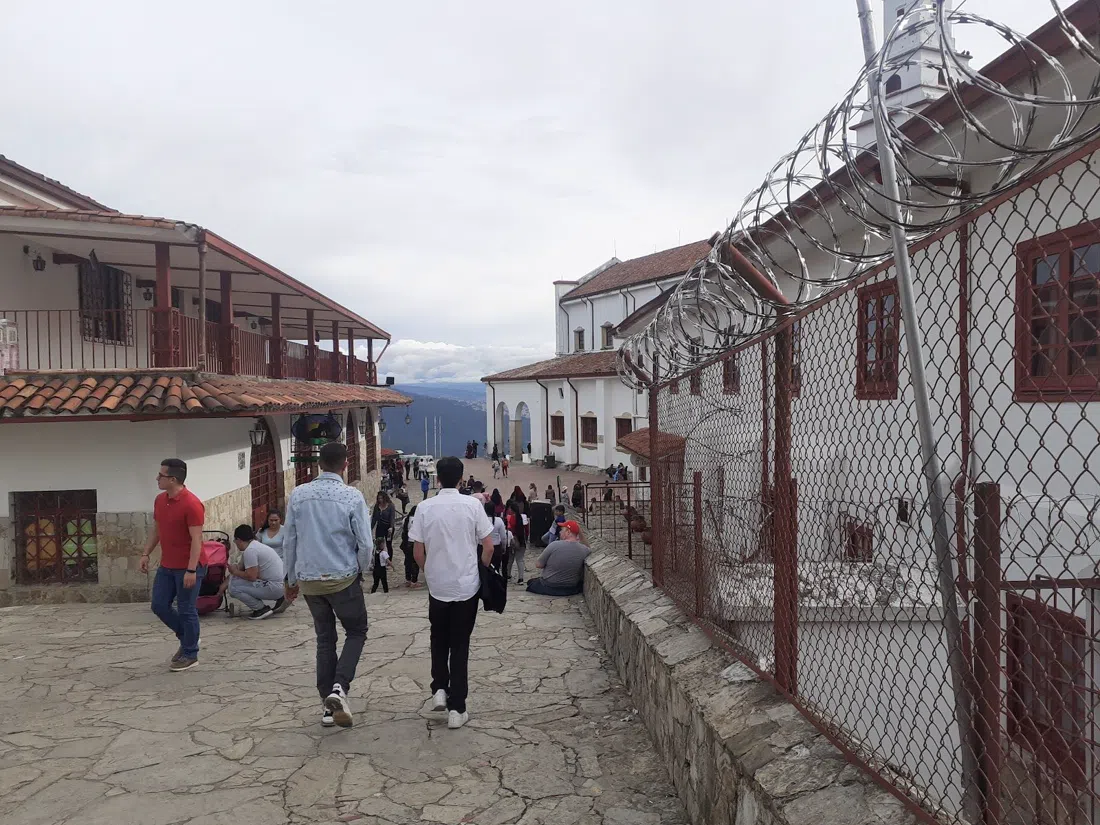
Mercado Artesanal de Monserrate (summit, the square behind the sanctuary) is the cheapest and most sociable way to eat up here: obleas, stuffed arepas, tamales and hot chocolate with cheese alongside ruanas, coffee and typical produce, roughly COP 10,000 to 60,000. Aisles are narrow, so a large party will bunch up and block them. Split into pairs and meet at the terraces.
Walking up instead of paying
Sendero Peatonal de Monserrate (lower station side) is the free ascent, and it deserves a real decision rather than a footnote. It is roughly 1,605 steps, open Wednesday to Monday from 5am for the climb, with the gates closing to upward traffic at 1pm and descent allowed until 4pm. It is closed on Tuesdays for maintenance. Sundays bring large local walking groups, which is good company and slow going.

The altitude is the part to respect. You are climbing stairs to 3,152 metres, and that is no casual stroll if you flew in yesterday. Give Bogota two days before you attempt it, carry water, and accept that a fit sea-level walker will still be stopping. Because the gates shut early, an afternoon arrival means buying a ticket whether you intended to or not; plenty of people discover that at the bottom of the steps at 1:30pm.
Tickets at the door versus booking a guide
For most independent travellers the door works fine. You buy at the lower station, you ride, and on a weekday morning the whole transaction is painless. The pressure points are Sundays, public holidays and the sunset hour, which is why the Fast Pass exists. If you are travelling with anyone who tires in a queue at this altitude, the priority lanes for seniors and reduced mobility do more for you than paying extra does.
A guided option does exist, and it is usually sold as a half-day of the historic centre with the hill attached rather than as Monserrate alone. It runs seven days a week and starts from 60 USD per person, a lot more than COP 35,000 of funicular, so buy it for the guiding and the transport between stops rather than for the ride. Across the bookable tours here there are 2,404 traveller reviews, with the leading one rated 4.9 out of 5 from 1,780 reviews, so the format clearly works for people who want someone else to handle the logistics. If you would rather be told what you are looking at than read it off a sign, book ahead; if you simply want the mountain, go yourself.
What sits at the bottom of the hill
Casa Museo Quinta de Bolívar (La Candelaria, Calle 21 No. 4A–30 Este) is the best pairing with Monserrate, mostly because it is a two-minute walk from the lower station. It is Bolívar's own country house and the most intact piece of colonial domestic architecture around the hill. Foreigners pay COP 15,000, Colombians COP 6,000, over-60s go free, and entry is free on Wednesdays 2pm to 5pm and on the last Sunday of each month. It opens Tuesday to Sunday 9am to 5pm and closes on Mondays, including holiday Mondays, which catches out a lot of long-weekend visitors. Larger parties should book.
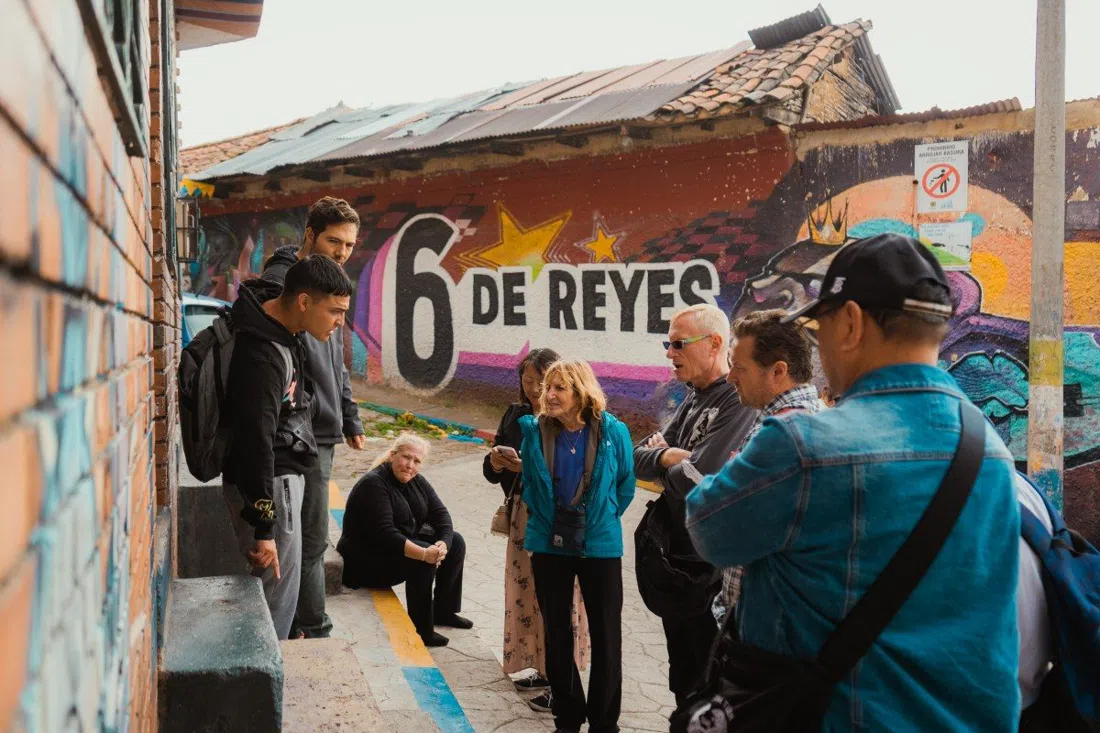
Barrio Egipto with Breaking Borders (Egipto, wedged directly under the hill) is the other thing worth your time down here. The walk is community-run and guided, operating since 2016 and still running in 2026 under the surviving co-founders and Viviana Ramírez, through a barrio that was once a no-go area and is now shown to visitors by the people who live in it. The fee is set by the community and booked direct. The rule is not negotiable: go with the community guides, never on your own.
An architecture day around the base station
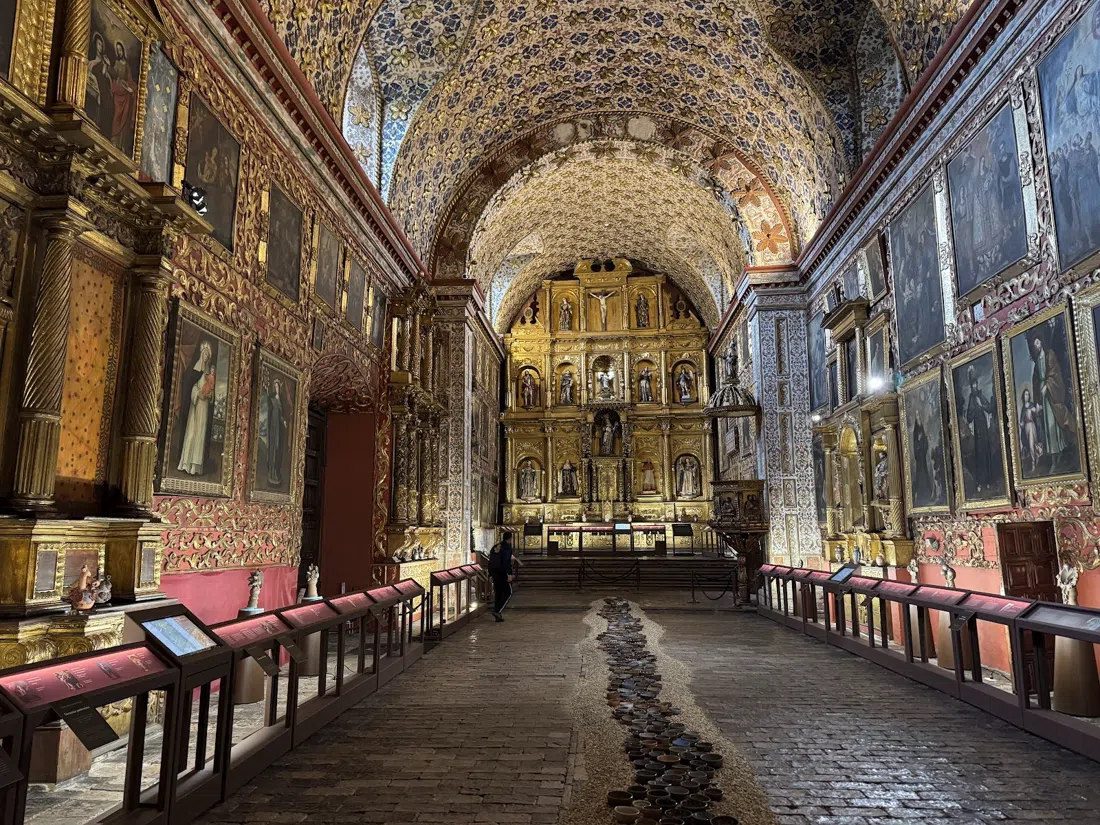
If the hill has put you in the mood for buildings, everything below is within walking distance of the base. Iglesia Museo Santa Clara (La Candelaria, steps from Plaza de Bolívar) is the strongest pure-architecture stop: a deconsecrated seventeenth-century nave kept as a museum, so you can stand still and study the gilded vault without a service going on around you. Foreigners pay COP 15,000, Colombians COP 5,000, students, teachers and seniors COP 2,000, under-12s free; Tuesday to Sunday 9am to 4:30pm, closed Mondays. The interior is small, so guided groups need to be modest in size.
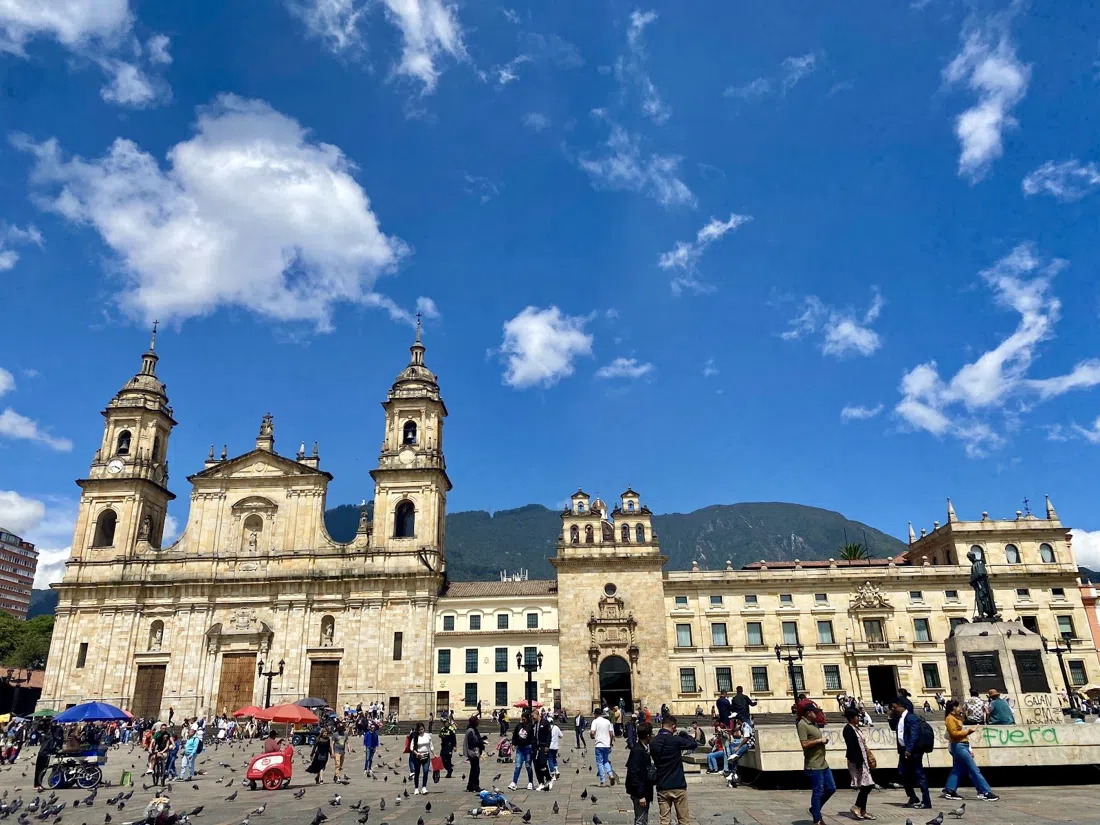
Catedral Primada de Colombia & Capilla del Sagrario (Plaza de Bolívar) is the civic counterpoint to the basilica above, neoclassical and institutional where Monserrate is small and devotional. Free, open daily 9am to 4pm, with Mass Monday to Saturday at noon and Sunday at 10:30am and noon; the adjoining Capilla del Sagrario keeps shorter hours of its own, Monday to Friday 6:30am to 4pm and Saturday 9am to noon.
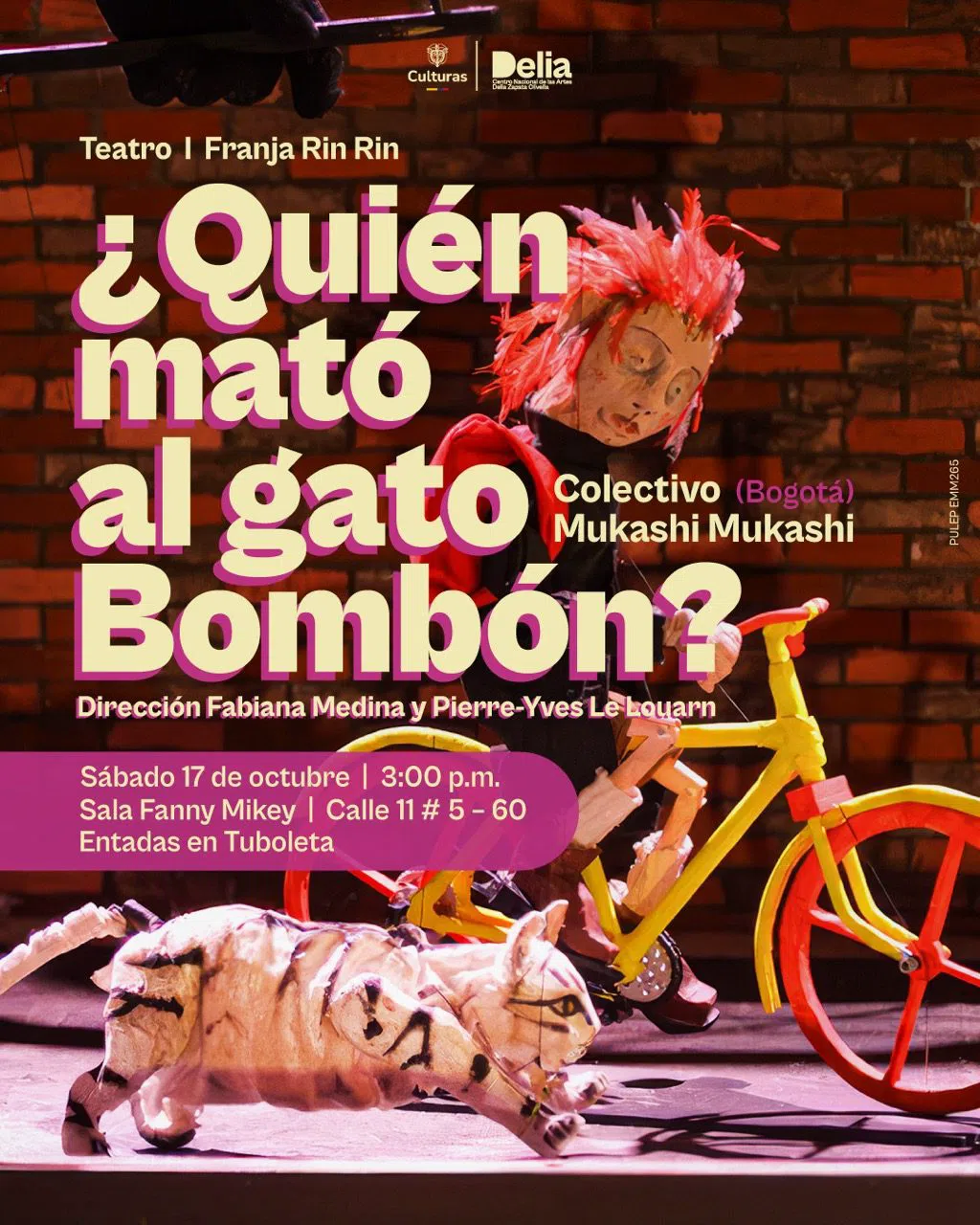
Teatro Colón (Centro Nacional de las Artes Delia Zapata Olivella) (La Candelaria) is the best-value architecture ticket in the city at COP 8,000 for a proper guided building tour: roughly 75 minutes through foyer, boxes, stage and lobby of Pietro Cantini's theatre, on Thursdays and Saturdays at 3pm and Sundays between 11am and 3pm, bought at the box office or through TuBoleta. Slots are capped at 25 people, so a group should take a whole slot rather than try to squeeze in.
Centro Cultural Gabriel García Márquez (La Candelaria, Calle 11 No. 5-60) is the modern half of the story and a deliberate break from all that colonial stock: Rogelio Salmona's brick masterpiece, with a bookshop, exhibition hall, café and terraces that look straight back up at the hill. Free, Monday to Friday 9am to 6pm, Saturday 9am to 7pm, Sunday 10:30am to 5pm, and an easy place to hold a group together.

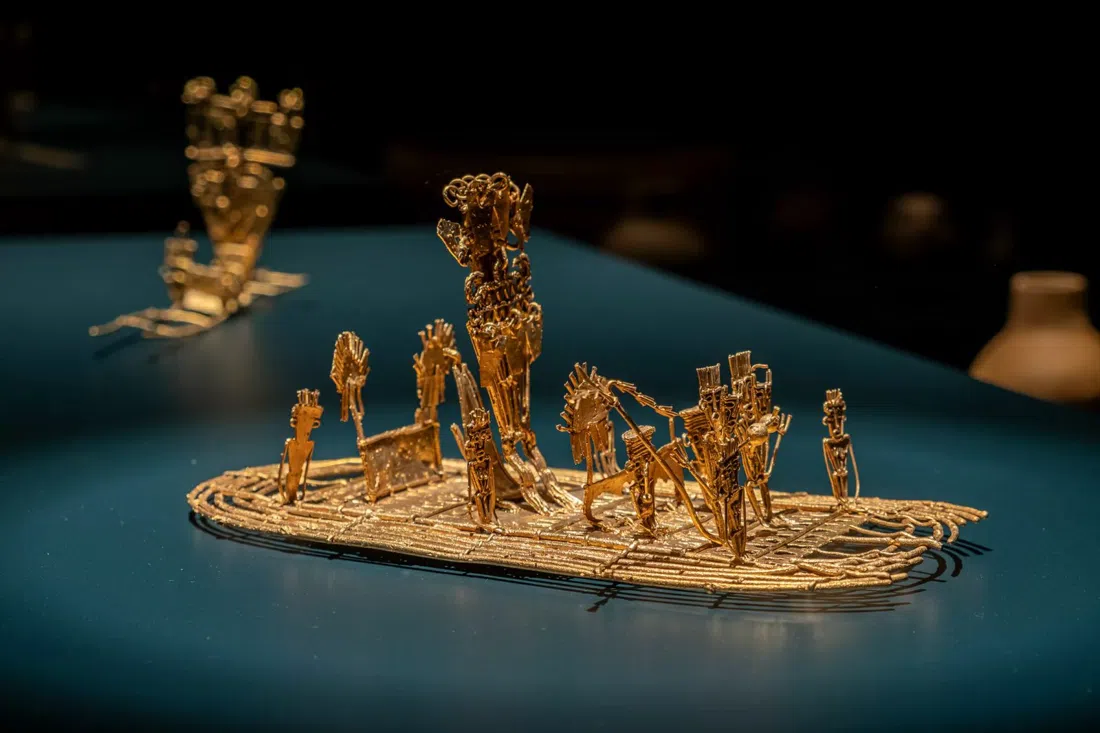
Museo del Oro (Parque Santander, a short walk north of La Candelaria) is the standard pairing with the mountain in any city itinerary: foreigners COP 21,000, free for everyone on Sundays, Tuesday to Saturday 9am to 7pm with last entry at 6pm, Sundays and holidays 10am to 5pm with last entry at 4pm, closed Mondays including holiday Mondays. One live caution: the permanent exhibition rooms have intermittent renovation closures in the window from 6 October to 6 November 2026, so confirm before you build a day around it.
Seeing Monserrate from the other side
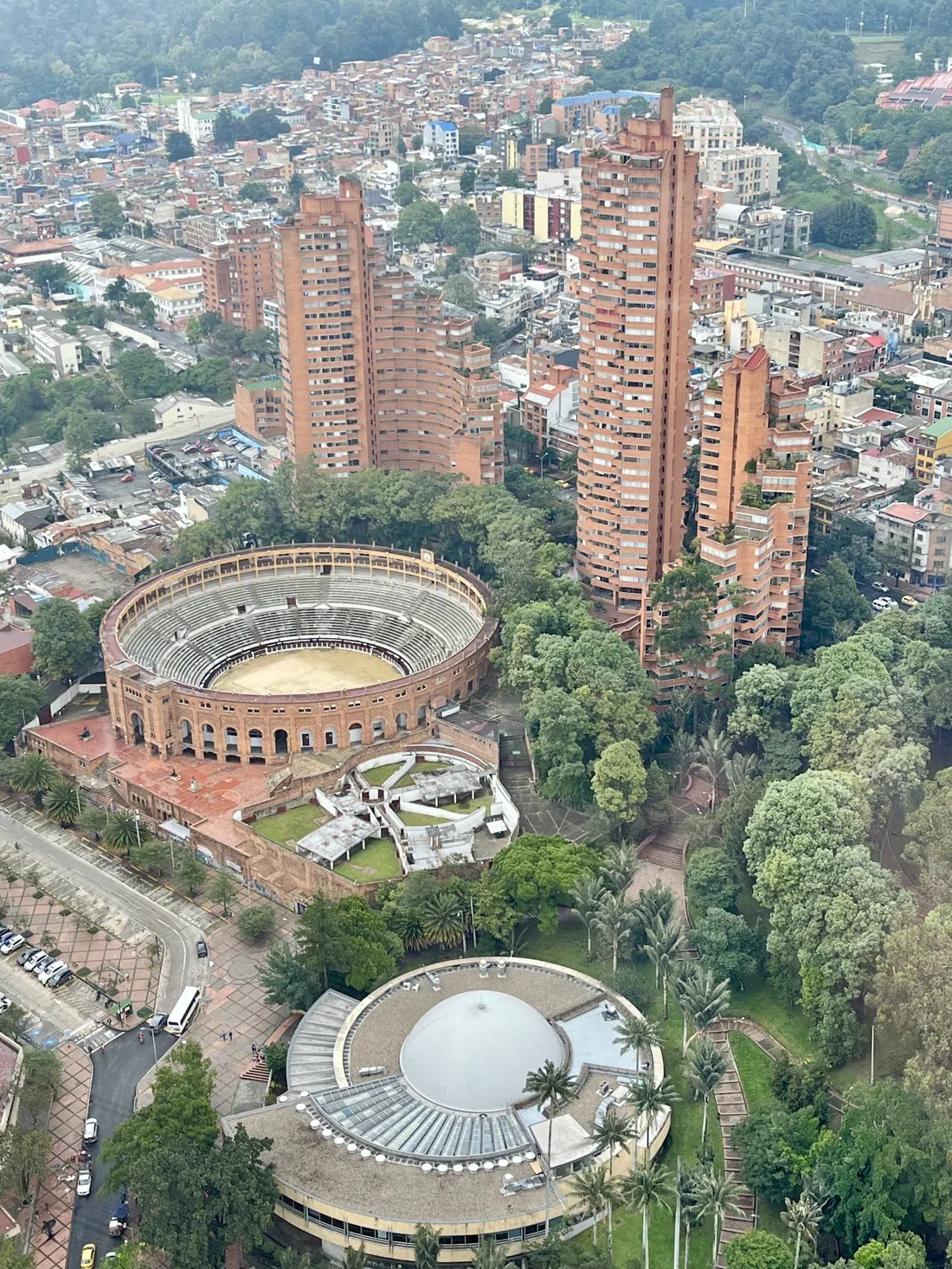
Mirador Torre Colpatria (Centro Internacional) is the reverse angle, and the reason to bother is specific. From floor 48 you look at the hill instead of from it, which is the shot that actually explains how Bogota is laid out against the mountains. It costs COP 18,000, under-3s free, and the lift does the work. The hours are narrow and trip people up: normally Friday 5:30pm to 8:30pm, Saturday noon to 8:30pm, Sunday and holidays 11am to 5pm, with seven-day opening only in holiday stretches, as it ran from 30 June to 2 August 2026. Capacity is limited, so large groups should expect to go up in waves.
Is it worth it
Yes, with one condition: go in the morning and treat it as half a day, not a photo stop. Monserrate works because three things sit on top of each other here. There is a mechanical ride that is fun in its own right, an active pilgrimage site that tells you something true about the country, and a terrace at 3,152 metres where the whole city lies flat below you. Skip any one of them and you have paid COP 35,000 for a view you could half-approximate from a tower downtown.
It suits almost everyone, but differently. Couples get the best of it midweek, early, with lunch at the top-end table. Families and pilgrims will find Sunday the natural day despite the crowds, because the fare halves and the atmosphere is at its warmest. Walkers with a few days of acclimatisation behind them should take the steps up and the cable car down. Anyone with a heart or breathing condition, or anyone who landed yesterday, should ride both ways and take the terraces slowly. The altitude is the real difficulty here, not the gradient.
Best time to go
Early morning on a weekday is the answer for almost every traveller. Between 6:30 and 9:00am the air is clearest, the cloud has not yet built over the plain, the queues are short, and the basilica is calm enough to sit in. The second-best window is after 3pm Monday to Saturday for sunset and the city lights, accepting a crowded rail and a cold wind.
By day of the week, Tuesday is the awkward one: the walking trail is closed for maintenance, the basilica does not open until noon, and there is no in-person Eucharist. Sunday is the cheapest fare and the fullest hill, with the top-end restaurant closed and the last ride down at 5pm, though the free Sunday entry at the gold museum makes a neat pairing below. Mondays close the house museum, the colonial church museum and the gold museum, holiday Mondays included, so a Monday is best spent on the mountain itself. And whatever day you choose, check the operator's site that morning to see which of the two rides is actually running.
Practical notes
The lower station sits at the top of a steep street east of La Candelaria, so a taxi or app car from the historic centre takes a few minutes and saves you a pointless uphill walk before the uphill ride. The Quinta de Bolívar is two minutes from the station on foot, and Plaza de Bolívar a flat ten-minute walk from there, so one trip can cover the hill and the colonial centre without a second car.
Buy the ticket at the station, and carry small Colombian peso notes for the artisan market, where stalls work in COP 10,000 to 60,000 amounts and card is not a given. The restaurants and museums are straightforward.
Allow three to four hours for the hill alone: the ride, the basilica, the Vía Crucis gardens, the terraces and something to eat. A lean day is COP 35,000 for the round trip plus COP 10,000 to 60,000 at the market. A full one is the round trip, lunch from around COP 35,000 at the traditional restaurant on the summit, COP 15,000 for the Bolívar house below and COP 8,000 for the theatre tour, still under COP 100,000 before dinner. Add the COP 96,500 Fast Pass only if your day has no slack in it.
Give yourself a day or two in the city before you go up, and take the official kit list at face value: light jacket, umbrella, sunscreen, proper shoes. The cobbles are steep and slick when the cloud comes in.
For somewhere to sleep within reach of the hill, start with a Bogota hotel search; for the rest of the city around it, the Bogota guide covers the neighbourhoods, food and getting around.