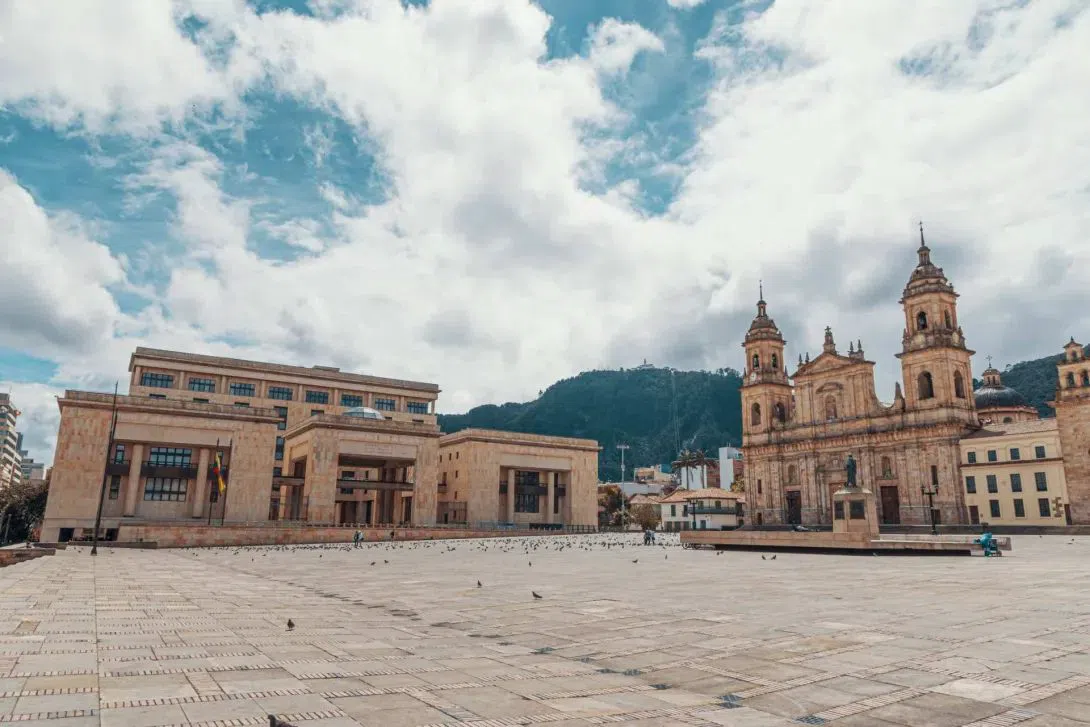
The square is flatter, greyer and far bigger than it photographs, and the first thing you register at 2,640 metres is the light: hard and white one minute, then flattened by cloud sliding off the eastern hills ten minutes later. Stand still in the middle for two minutes and you are looking at roughly four hundred years of Colombian building at the same time, a 17th-century chapel on one corner and a courthouse rebuilt after a siege on the other. Most visitors cross it in six minutes, photograph the pigeons, and never work out what a single facade is telling them.
What you are actually looking at
Plaza de Bolívar (La Candelaria) is fully public and unticketed, which is why it works so well as an architecture lesson: you can stand in the centre of it for an hour for nothing and read the timeline straight off the walls. Guides almost always brief groups either on the Capitolio steps or beside the Bolívar statue, because those are the two spots where you can see all four sides without turning your head twice.
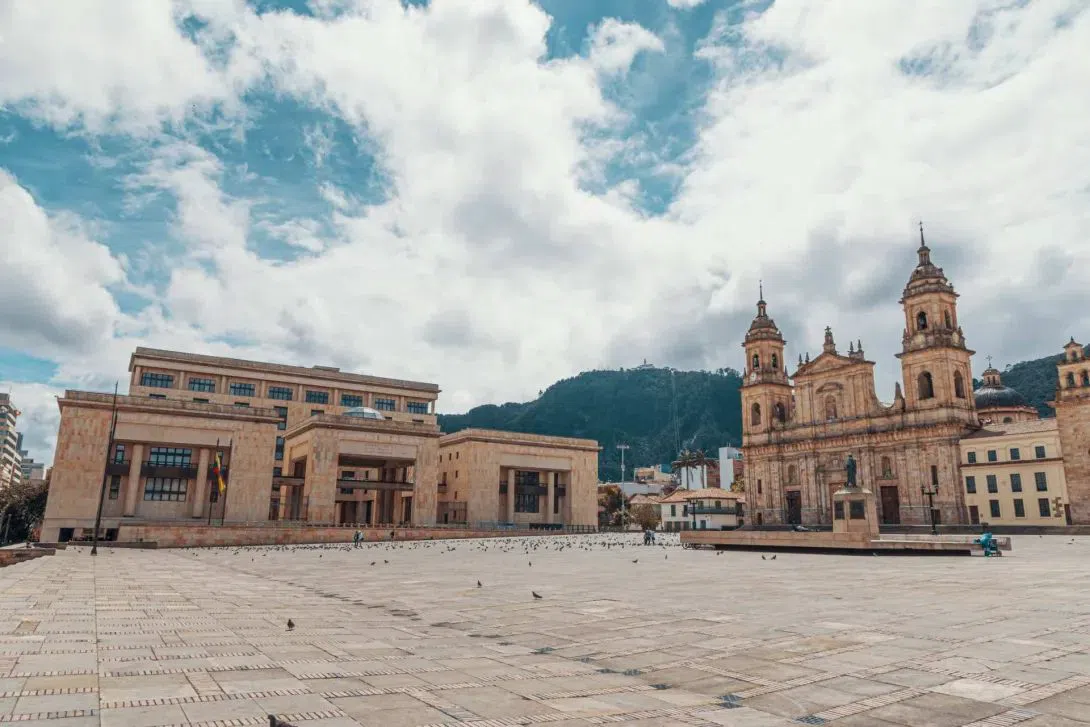
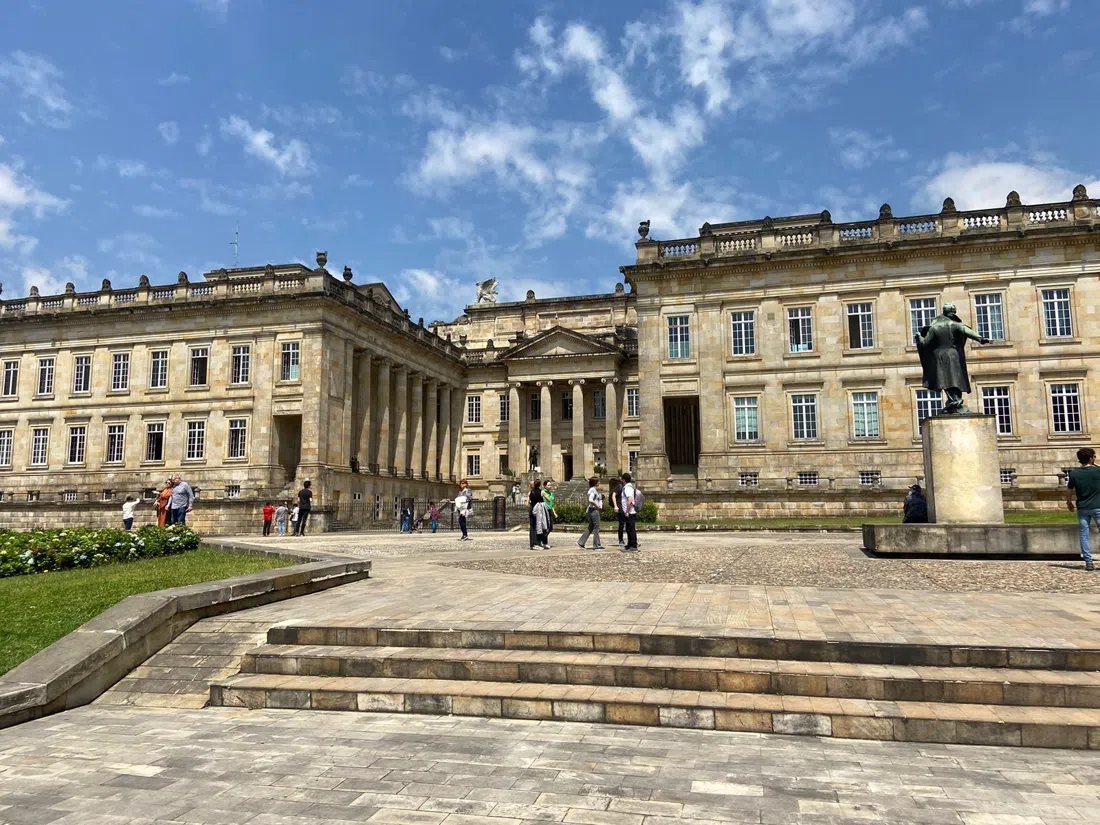
Face south and you have the long horizontal colonnade of the Capitolio Nacional (La Candelaria), eighty years in the building between 1847 and 1926, a stop-start century of Colombian politics visible in the stone joints. West is the Palacio Liévano (La Candelaria), begun in 1902 in a French academic manner that has almost nothing in common with its neighbours; it has been a declared national monument since 1984, and it is the outlier that makes everything else on the square legible. North is the Palacio de Justicia (La Candelaria), architecturally the most loaded building here: the 1960s modernist original was destroyed in the 1985 M-19 siege and the army's retaking of it, and the replacement was deliberately designed to echo colonial patios, domes and arcades while pulling the plaza's space inward rather than shoving a facade out at it. East are the square's two churches, and they are the two interiors you can simply walk into.


Two of those four buildings are shut, and it is worth knowing that before you build a day around them. Palacio Liévano is the working seat of the mayor and its interiors are security-restricted, not on general public visit. Palacio de Justicia is an active court with no general public entry. In both cases you look and photograph from the plaza, and groups stopping on the pavement outside are normal and tolerated. That is the whole visit for those two, and anyone promising more is wrong.
The plaza is also the country's main protest stage. Marches, rallies and staged civic events regularly fence it off or fill it completely. The city publishes the week's demonstrations in advance, so a ninety-second look at the schedule the night before saves you from arriving to find barriers where you wanted to stand.
Two free interiors on the east side
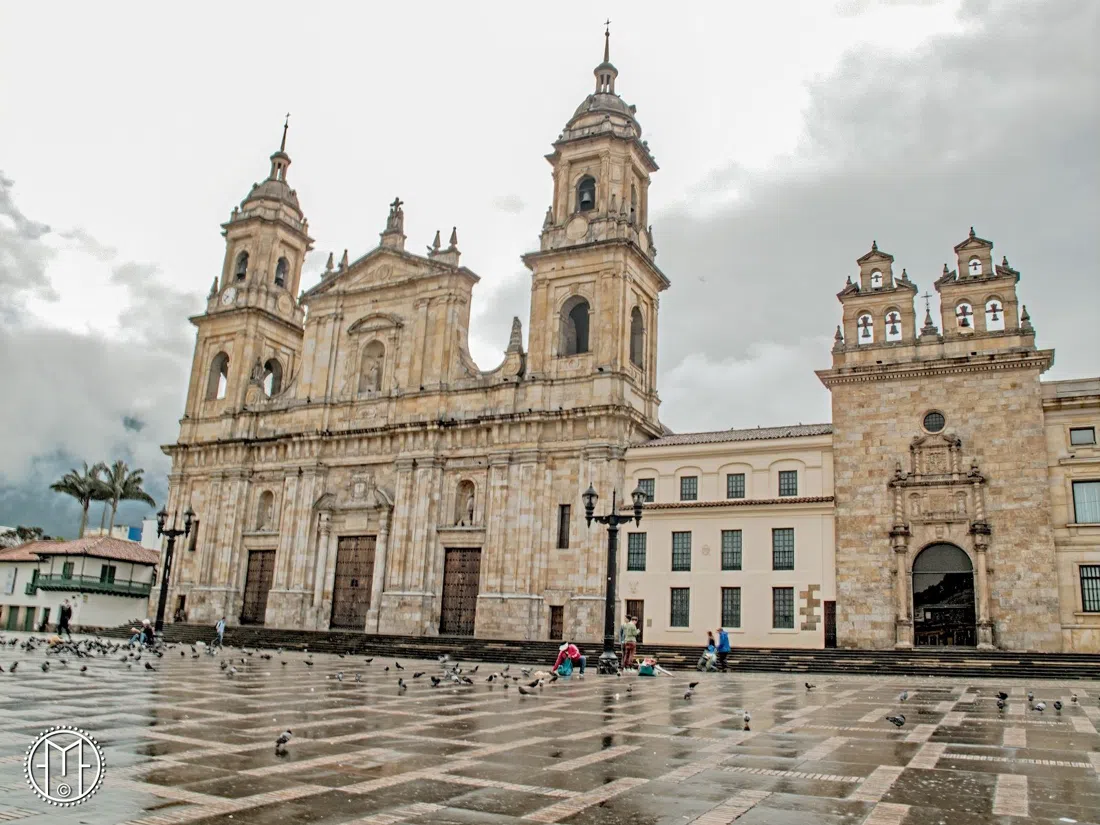
Catedral Primada de Colombia (La Candelaria) is the plaza's neoclassical set-piece and the largest church in the country, finished in 1823 on the site of three earlier cathedrals, which is itself the point: the square kept rebuilding on its own footprint rather than moving. Walk-in visitors are welcome daily from 9am to 4pm at no charge, with a donation box at the door. The side chapel holds the tomb of the city's founder, Gonzalo Jiménez de Quesada. Guided groups are admitted but must stay quiet and out of the aisles during the midday Mass. Simpler than working around it: time your visit away from the 12:00 daily Mass altogether and you get the volume, the light and the sightlines you came for.
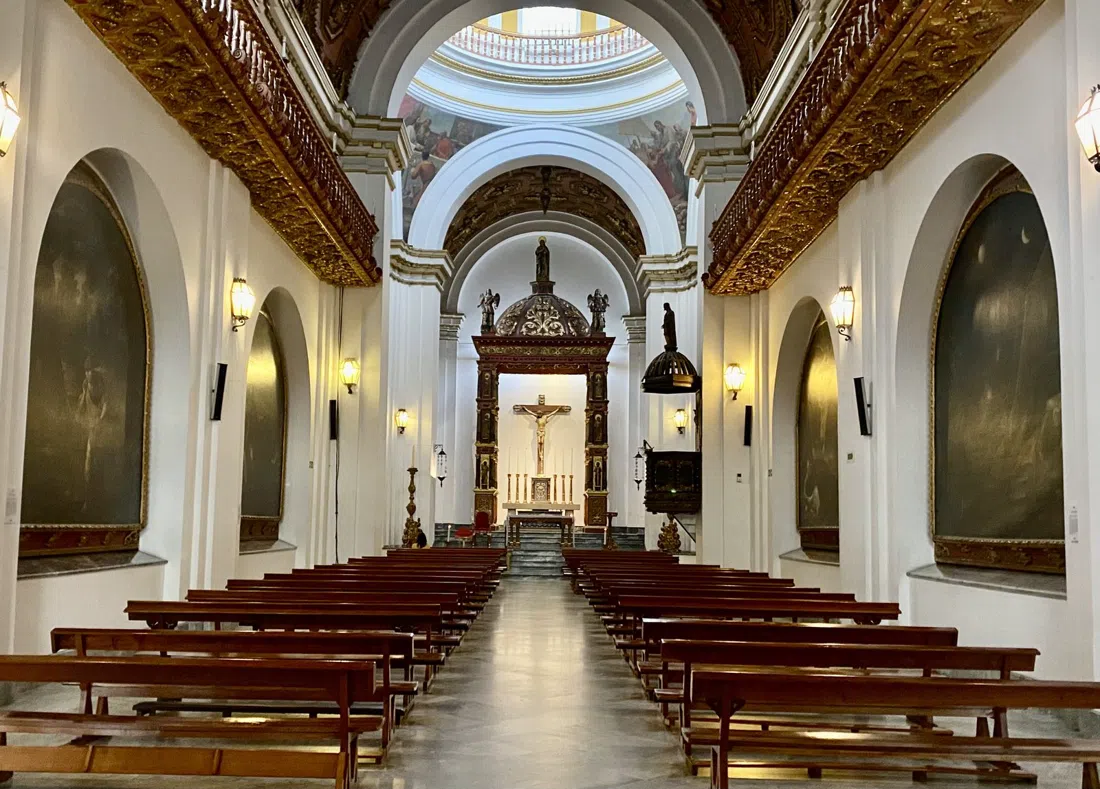
Next door, Capilla del Sagrario (La Candelaria) is the single best interior on the square if architecture is genuinely why you came. It is a 17th-century Santafereño chapel with a Moorish-derived wooden vault overhead and canvases by Gregorio Vásquez de Arce y Ceballos on the walls, and it is free. It is also a genuinely small room. Large groups are asked to enter in halves, so guides explain the building outside first and then send people in. If you are two or four, that constraint never touches you, one of the few cases where independent visitors have the clear advantage. It opens Monday to Friday, 6:30am to 4pm, and closes at weekends, which is what ruins Saturday itineraries here every week.
The interiors worth booking weeks ahead
Three doors in the historic centre open properly, and all three need planning.
The Capitolio Nacional runs free guided visits on Fridays only, roughly 9:00am to 12:30pm, booked in advance through the Congress. Groups are capped at 35 and every person needs photo ID. It is the one plaza-front interior you can actually get into with a guide, and the tour is built for exactly this subject: it opens with an explanation of every facade on the square before going inside. If your trip includes a Friday morning, give it that Friday morning. If it does not, accept you will only ever see this building from outside.
Casa de Nariño (La Candelaria) sits two blocks south of the plaza and is the most under-used architecture stop in the centre. Free 45-minute guided visits run Monday to Saturday from 9:00am and on Sunday and holiday afternoons, by advance online booking only, with a strict cap of 20 people per group and ID required for everyone. Book weeks out. The cap fills fast, and no-shows are not replaced at the door, so turning up hopefully is a wasted walk.
Teatro Colón (La Candelaria), one street behind the plaza, is Pietro Cantini's theatre of 1885 to 1895 and the best-value guided interior in the district. Tours run Wednesday and Thursday at 3pm and Saturday at 12pm and 3pm, last about 75 minutes, cost a low ticketed fee, and are capped at 25 people, so book ahead for any group. You get foyer, boxes, dressing rooms and the stage itself, which is more of a working building than most heritage tours ever show you. Tours are suspended around performances and rehearsals, so confirm your specific date rather than trusting the general timetable.
Four small museums inside a five-minute radius
Museo de la Independencia – Casa del Florero (La Candelaria) is the oldest domestic building still standing on the square, and the easiest way to understand what 16th and 17th-century Santafé housing actually was (room sizes, ceiling heights, how a house met the street), quite apart from the 1810 independence story attached to it. Open Tuesday to Sunday, 9am to 5pm on weekdays and 10am to 5pm at weekends, closed Mondays, a few thousand pesos in, free on Wednesdays between 3 and 5pm and on the last Sunday of the month. The rooms are small, so tour groups get split and staggered.

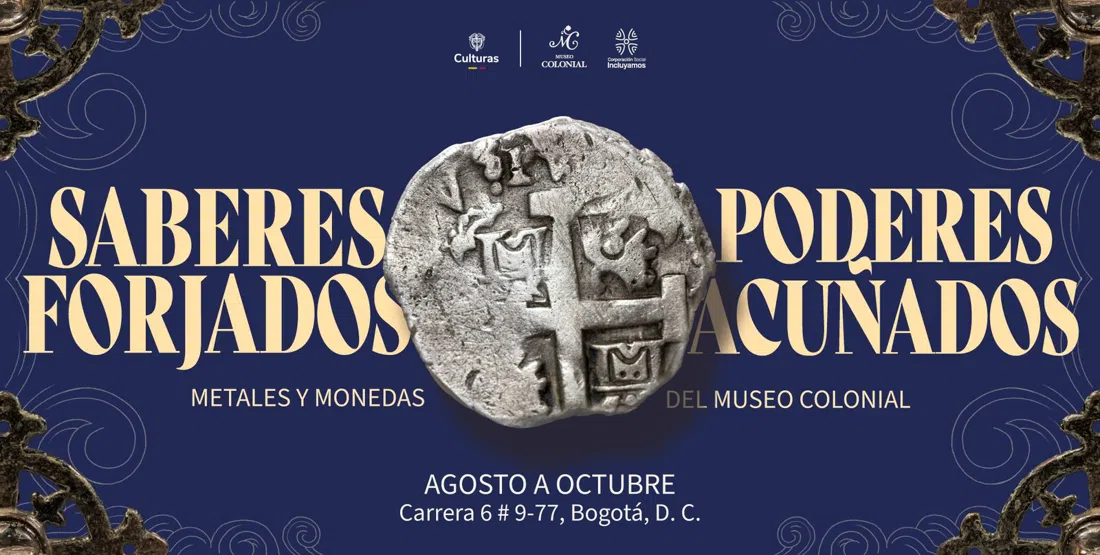
Museo Colonial (La Candelaria), a block off the plaza in a former Jesuit cloister, is the clearest single lesson in Spanish colonial construction anywhere in the city: the building is as much the exhibit as the paintings. Tuesday to Sunday, 9am to 5pm, closed Mondays, roughly COP 2,000 to 6,000 depending on age, free on the same Wednesday and last-Sunday slots. Over-60s enter free. It takes school and tour groups routinely; book if you are more than about fifteen.
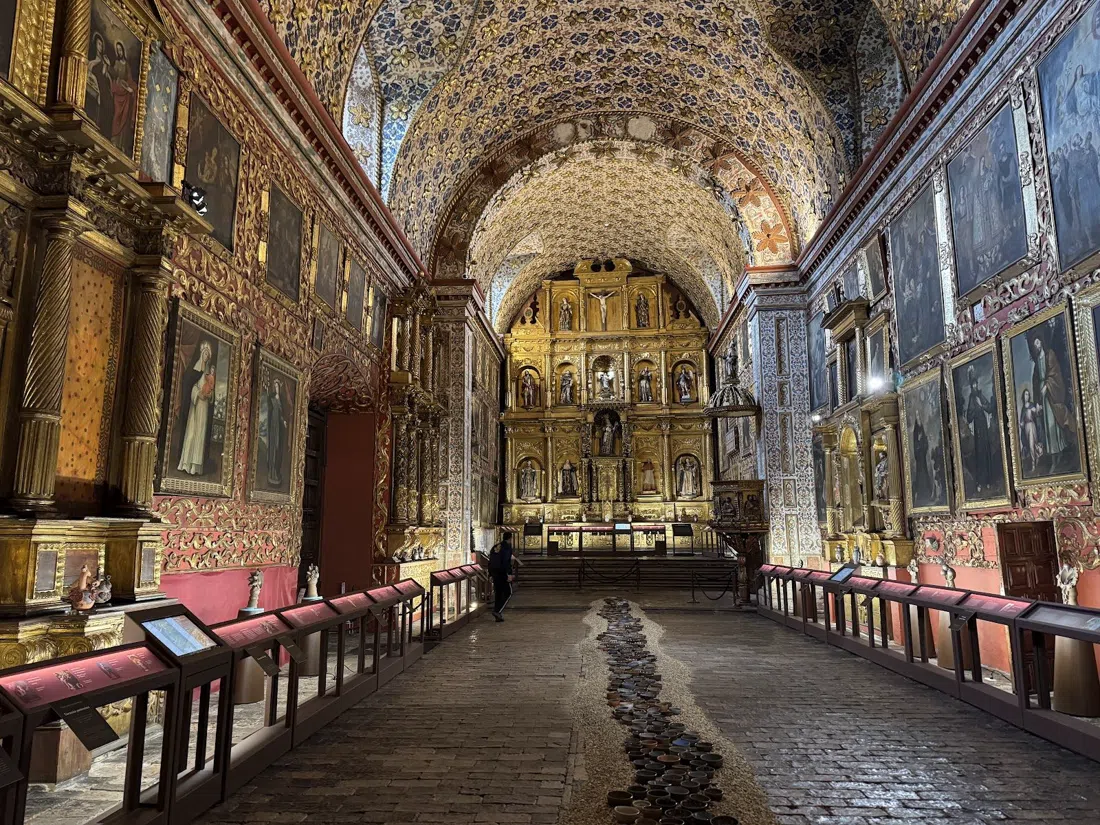
Iglesia Museo Santa Clara (La Candelaria) was built in 1647 for the Royal Convent of Santa Clara and is the most visually overwhelming interior within five minutes of the plaza. If you only have time for one baroque interior beyond the cathedral, make it this one. Tuesday to Sunday from 9am, closed Mondays, a few thousand pesos, free on the same days as the Museo Colonial. It is one room, so guides brief outside and send people in in waves.
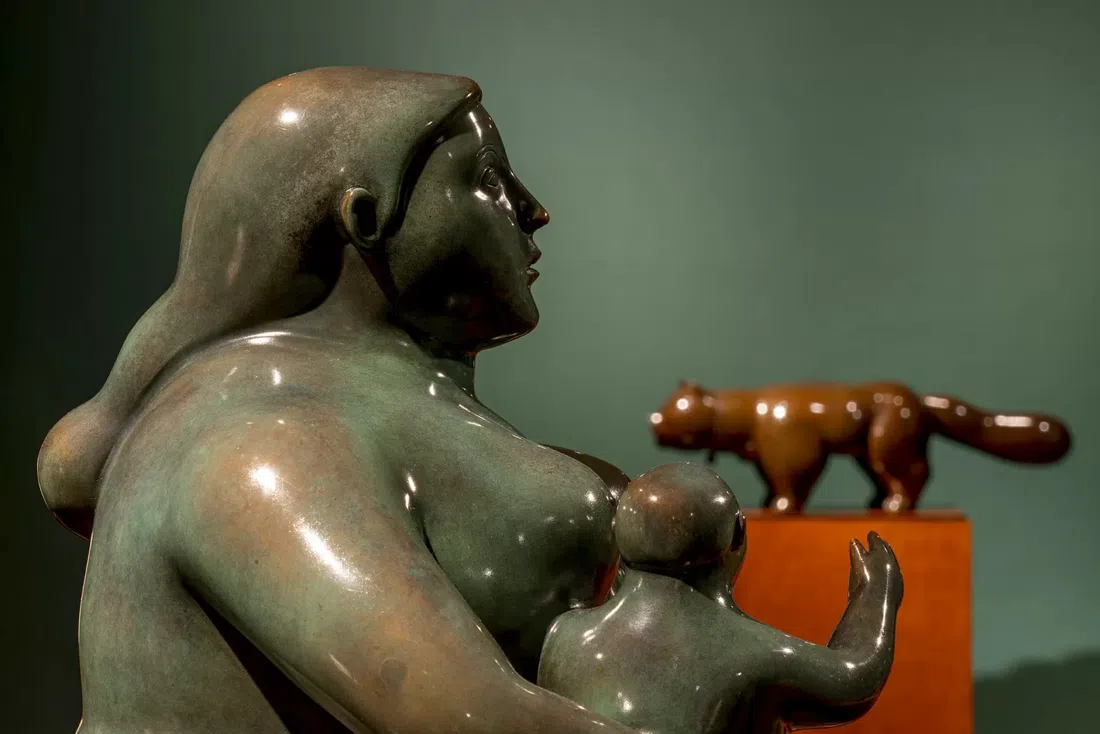
Museo Botero (La Candelaria) is free, central, needs no reservation and sits inside a handsomely restored colonial mansion, which makes it an architecture stop in its own right as well as the obvious wet-weather fallback. Inside are 123 Botero works plus 85 international pieces the artist donated. Open Monday and Wednesday to Saturday 9am to 7pm, Sundays and holidays 10am to 5pm, closed Tuesdays. That Tuesday closure wrecks more Bogota itineraries than any other single opening hour in the centre, so check the day of the week you are reading this for.
Salmona's brick answer a short walk north
Centro Cultural Gabriel García Márquez (La Candelaria) is the answer to anyone who assumes this district stopped building in 1900. Rogelio Salmona's curved brick building of 2008 is the one genuinely modern masterpiece in the historic centre, free to enter, with a bookshop open roughly Monday to Saturday 9am to 7pm and Sundays and holidays from 10:30am. Large groups are fine in the public halls and on the terraces, and those terraces give you the best free elevated view over the old-town rooftops, worth ten minutes purely to see how the plaza's block sizes repeat across the district.

Going up to see the plaza as one rectangle
Cerro de Monserrate (eastern hills above La Candelaria) is the context shot for everything you have just looked at from street level. From 3,152 metres the plaza resolves into one deliberate stone rectangle punched out of the colonial grid, and the relationship between the square and the mountain (the real reason the city sits where it does) becomes obvious in a way no facade can tell you. The funicular and cable car run roughly 6am to 7pm most days with extended evening hours at weekends, and the return fare is around COP 35,000; early-morning single fares start from about COP 10,500. Preferential group and school rates are offered explicitly, and groups board in batches.
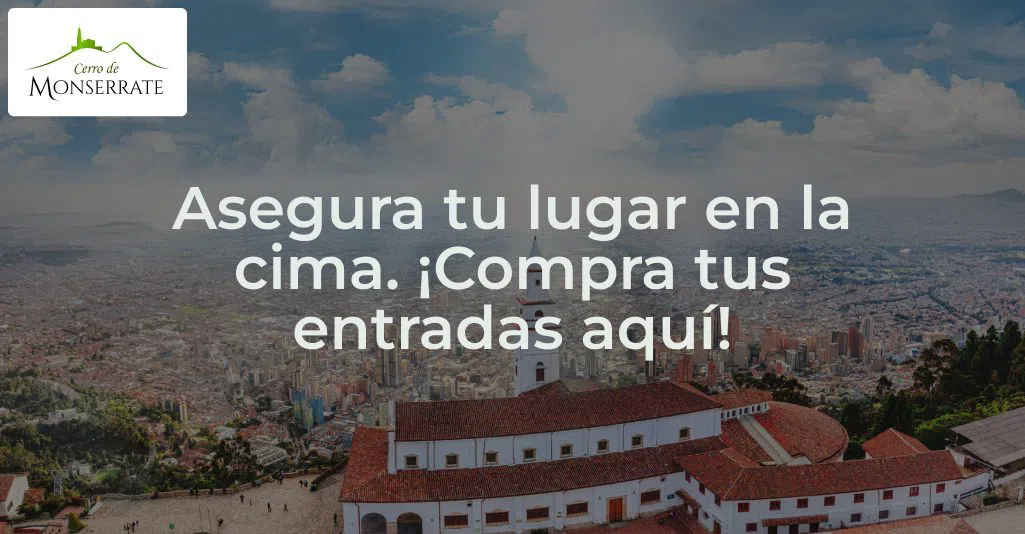
Go early. The queue and the cloud both build through the morning, and the cheapest fares are before 9am. At this altitude, if you have flown in the day before, do Monserrate on day two or three, not day one.
How long it takes, and whether to take a guide
The square itself is a 30 to 45-minute stop if someone is explaining the facades to you, and about fifteen minutes if nobody is. Add the cathedral and the Sagrario and you have a comfortable 90 minutes without entering anything ticketed. A full architecture morning (plaza, both churches, one museum, the García Márquez terraces, ending on a coffee) runs three to four hours on foot. Bolt on Monserrate and you have lost the day, happily.
Nothing on the square needs a ticket, so there is no queue to skip and no door fee to save; the two things booking ahead actually buys you are the capped interiors (Capitolio on a Friday, Casa de Nariño's 20-person groups, Teatro Colón's 25) and someone who can tell you why the Palacio de Justicia has arcades. Guided architecture walks of the centre run 7 days a week and start from 60 USD per person for the private options, with cheaper group walks available; across the bookable tours here there are 3,520 traveller reviews, and the top-rated one sits at 4.9 out of 5 from 1,773 of them. That is a solid signal rather than a reason to book blind. Read what the reviews say about the guide's grasp of the buildings, because a street-art walk and an architecture walk cover the same pavement very differently.
The plaza is worth an hour of anyone's time and costs nothing, and it is far better with a guide than without. If you have a real interest in colonial and post-colonial building, pay for the walk or read up properly beforehand. Unexplained, this square underwhelms people, and that is the most common complaint about it. If you are travelling as a couple or a pair, you will get into the small interiors (Sagrario, Santa Clara, La Puerta Falsa) far more easily than any group will. If you are a group of more than fifteen, book everything, split for the small rooms, and expect to be staggered.
Best time to go
Early morning, Tuesday to Friday, is the answer for almost everyone. The light is cleanest before about 10am, the cloud has not yet closed over the hills, the cathedral is quiet, and you are clear of the 12:00 Mass. Friday morning is the strongest single slot of the week if you have booked the Capitolio, because you can chain the Congress tour straight into the churches afterwards.
Avoid Mondays, when the Casa del Florero, Museo Colonial and Santa Clara all close, and avoid Tuesdays if you want the Museo Botero. Saturdays lose you the Capilla del Sagrario entirely, though Teatro Colón's two Saturday tours partly compensate. Weekends fill the square with families, buskers and occasional staged events; that is atmospheric, but it is not when you photograph facades. Bogota's rain arrives mostly as afternoon showers year-round rather than in a clean dry season, which is a further argument for front-loading the outdoor half of the day and keeping the Museo Botero or the García Márquez building in reserve.
Chocolate, ajiaco and somewhere to sit
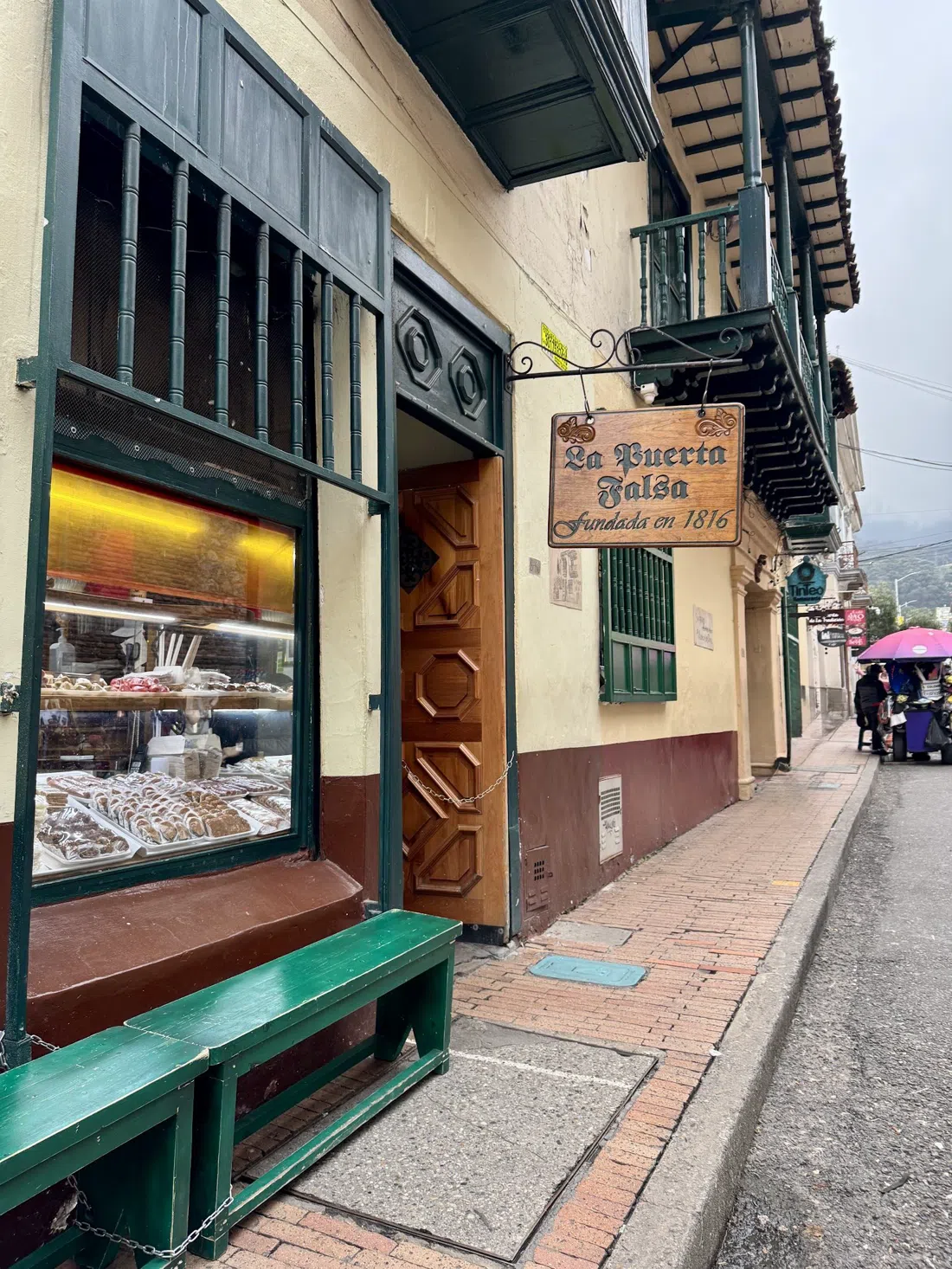
La Puerta Falsa (La Candelaria) has been open since 1816 and is a minute from the plaza, which makes it the default stop for chocolate santafereño, a tamal or a bowl of ajiaco at a few dollars' worth of pesos. It is also genuinely tiny and almost always queueing: fine for two or four, impractical for a group, and guides tend to point people towards it after a tour rather than try to seat everyone. Do not plan a meal around it; plan a snack and a wait.
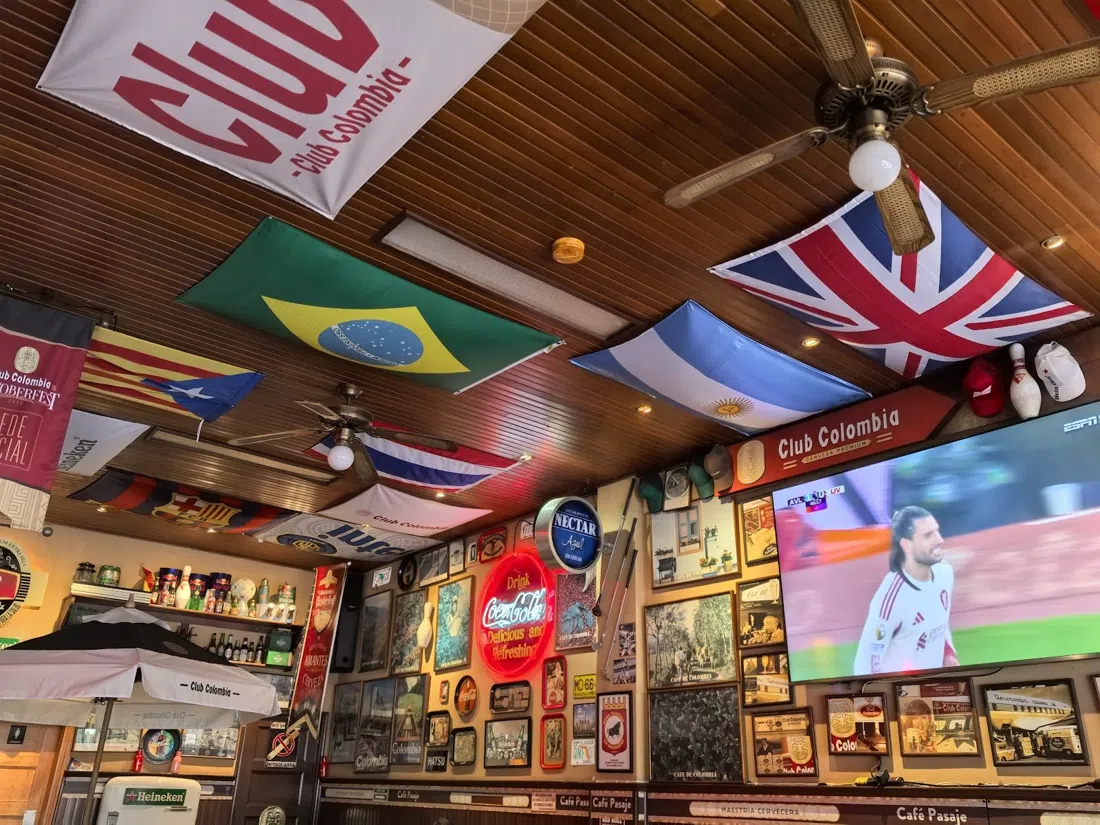
Café Pasaje (Plazoleta del Rosario) has traded on its little square since 1936, beside the colonial Colegio Mayor de Nuestra Señora del Rosario, and it is a working café rather than a heritage exhibit. Open daily from around 9am and late on Fridays, walk-in only, cheap for a coffee and a pastry. It is the right place to end a morning on foot before the walk back down Carrera Séptima.
Practical notes
Come up to the plaza on the TransMilenio and walk in. The historic centre is compact enough that everything above sits inside a ten-minute radius of the Bolívar statue, and a taxi through the centre's one-way grid is usually slower than your own legs. Wear shoes you can walk cobbles in, and carry a layer plus something waterproof: at this altitude the temperature swings sharply the moment the sun goes behind cloud.
Carry small pesos in cash. The museums here cost thousands rather than tens of thousands, the cafés are cash-friendly, and a COP 50,000 note for a COP 3,000 entry is a nuisance for everyone. Budget honestly: a self-guided architecture morning costs almost nothing beyond a coffee, adding two small museums keeps you under COP 15,000, and Monserrate's roughly COP 35,000 return is the single biggest line on the day unless you book a guide. Bring photo ID every day you are in the centre, because the Capitolio and Casa de Nariño both require it per person and there is no way around that at the door.
Stay in or just north of La Candelaria and you can be on the square before the queues form; the Bogota hotel search covers both the historic centre and the quieter business districts a short ride away. For what to do with the rest of your days here, the wider Bogota guide picks up where this square leaves off.